

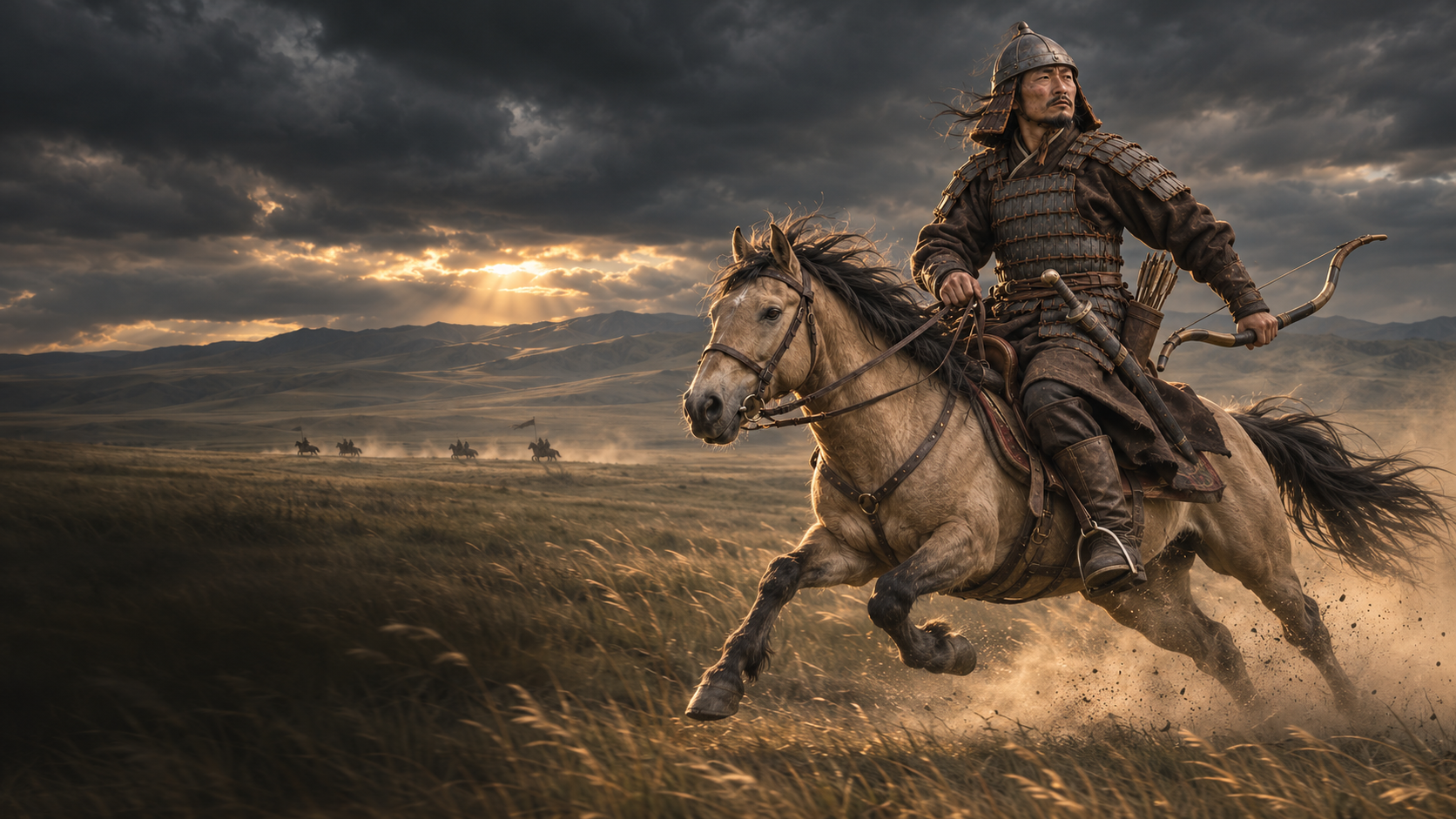
Lords of Showdown · Card 003 · Blades & Bows
His opponent has to close the distance. The rider can choose whether to let him.
Chase a Mongol horse archer and you might ride straight into the fight he wants. Hold your ground and he can keep shooting. Card 003 follows an imagined veteran around 1230, when Genghis Khan’s successors were still expanding the empire he founded. What happens when this rider runs out of room?
See how he fought on horseback ↓
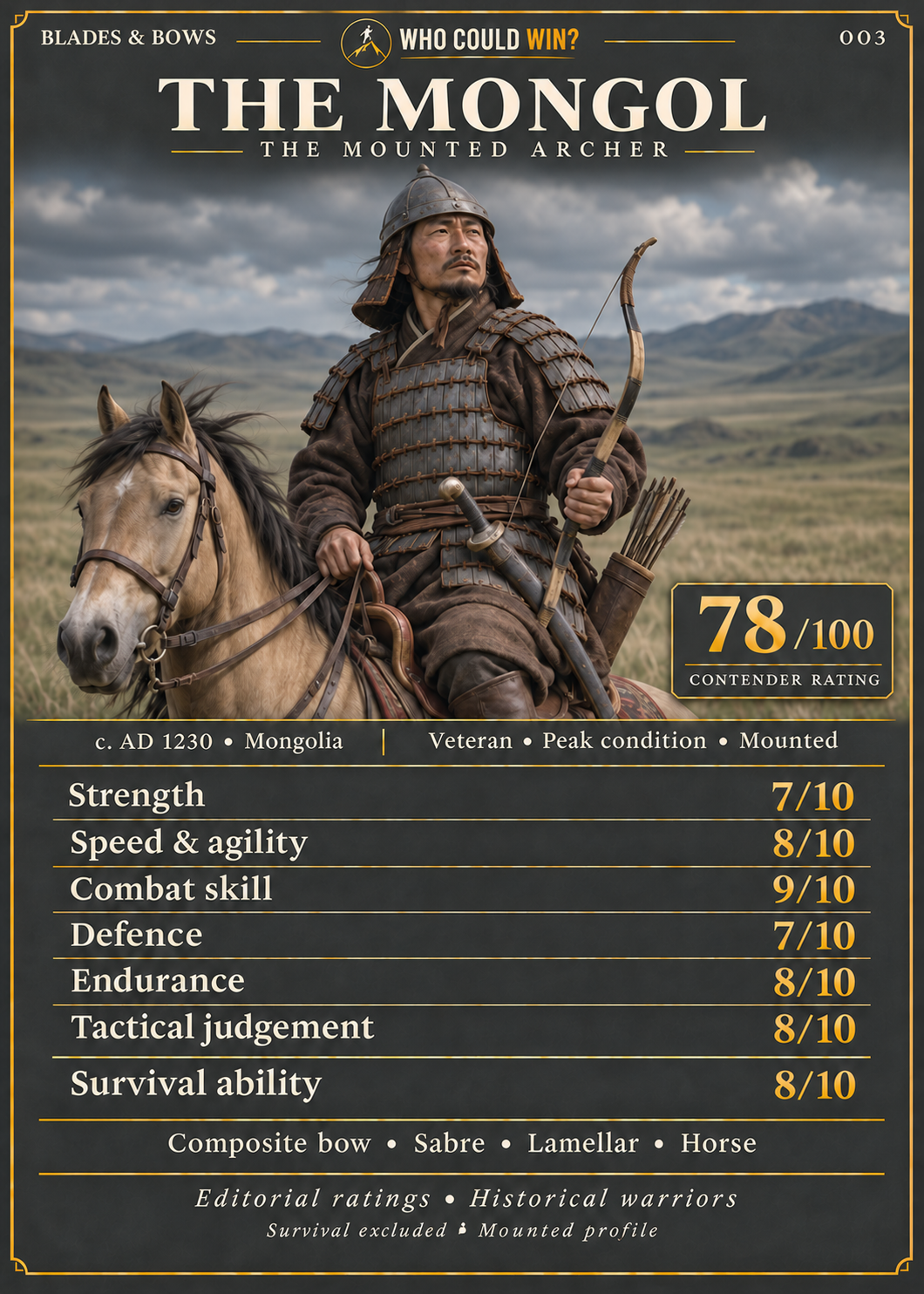
- Setting
- Mongolia, c. AD 1230
- Role
- Mounted veteran in peak condition
- Card equipment
- Composite bow, sabre, lamellar armour and horse
- Contender rating
- 78/100 · editorial
- Card ratings
- Strength 7, speed and agility 8, combat skill 9, defence 7, endurance 8 and tactical judgement 8 (all out of 10).
- Survival ability
- 8/10 · scored separately
When were the Mongol horse archers at their height?
Mounted archery had deep roots on the Eurasian steppe. The Mongol Empire dates from 1206, when Temüjin took the title Genghis Khan. The first half of the 13th century is the period to watch for this card, from his early conquests through the campaigns of his successors. Around 1230, the empire was under Ögedei, who had succeeded his father. The united empire fractured after 1260, and successor states carried on Mongol military traditions. Cambridge history of the early Mongol Empire
What weapons and armour did a Mongol rider carry?
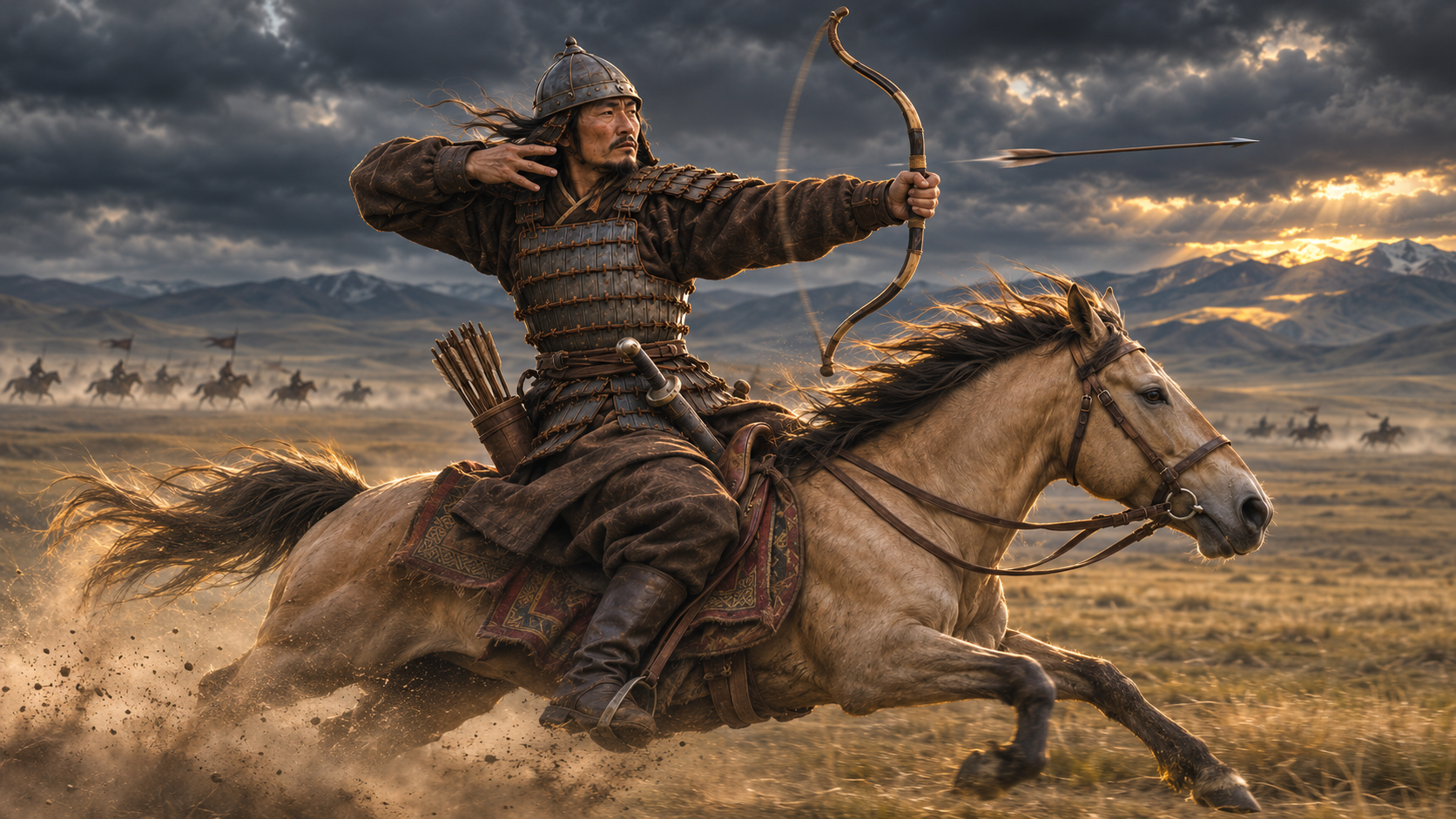
Composite bow and arrows. The bow combined a wooden core with horn and sinew. Its compact form suited shooting from the saddle. A quiver kept arrows within reach while the rider manoeuvred.
Sabre and lamellar armour. The curved blade on Card 003 gives our rider an option at close quarters. His armour consists of small plates laced together over a long riding coat. Trousers and boots fit a life spent in the saddle. The illustration shows one plausible kit. Equipment varied across an empire whose armies drew on many peoples and included troops equipped for close combat and sieges. Smithsonian exhibition catalogue on Mongol equipment and tactics
How did Mongol horse archers fight?
A good rider could steer and balance while both hands worked the bow. A formation could do far more than a single rider. Mounted units could harass a line, withdraw to draw men out of position and turn back once pursuers had lost cohesion. Spare horses helped keep an army moving over long distances. The advantage came from the combination of riding, archery and coordinated movement. Cambridge history of the Mongol military
Who was his most likely enemy?
The Jurchen-led Jin dynasty is the strongest choice for this card. It ruled northern China, and Ögedei renewed the campaign against it around 1230. The Jin fought on until 1234. Its fortified cities posed a problem that archers in the open could scarcely solve on their own. The Mongols also needed siege forces and the expertise to take defended positions. Virginia Museum of Fine Arts timeline · Cambridge on siege warfare and the Mongol army
Did Mongol forces ever fight samurai? Yes. Forces sent by Kublai Khan attacked Japan in 1274 and 1281. Those defenders belonged to Kamakura Japan. Our Samurai card is set around 1580, about three centuries after the invasions. National Archives of Japan on the Mongol invasions · Read Card 001 · The Samurai
How tall was a Mongol warrior?
There’s no reliable average for Mongol mounted warriors around 1230. A study of the elite Tavan Tolgoi burials in Mongolia reported estimated heights of 169.8 cm (about 5 ft 7 in) and 165.6 cm (about 5 ft 5 in) for two individuals. Those estimates show what researchers could recover from particular skeletons. A pair of elite burials is too small and selective a sample to establish an army-wide average. Read the Tavan Tolgoi burial study
What was the Mongolian steppe like around 1230?
Cold winters and the availability of summer pasture mattered to households that depended on herds. Central Mongolian tree rings point to unusually wet conditions from 1211 to 1225, followed by several years of drought beginning in 1226. That gives us evidence for changing pasture conditions in the card’s wider setting. The storm in the hero image is imagined. Read the central Mongolian tree-ring study
What did a Mongol warrior eat?
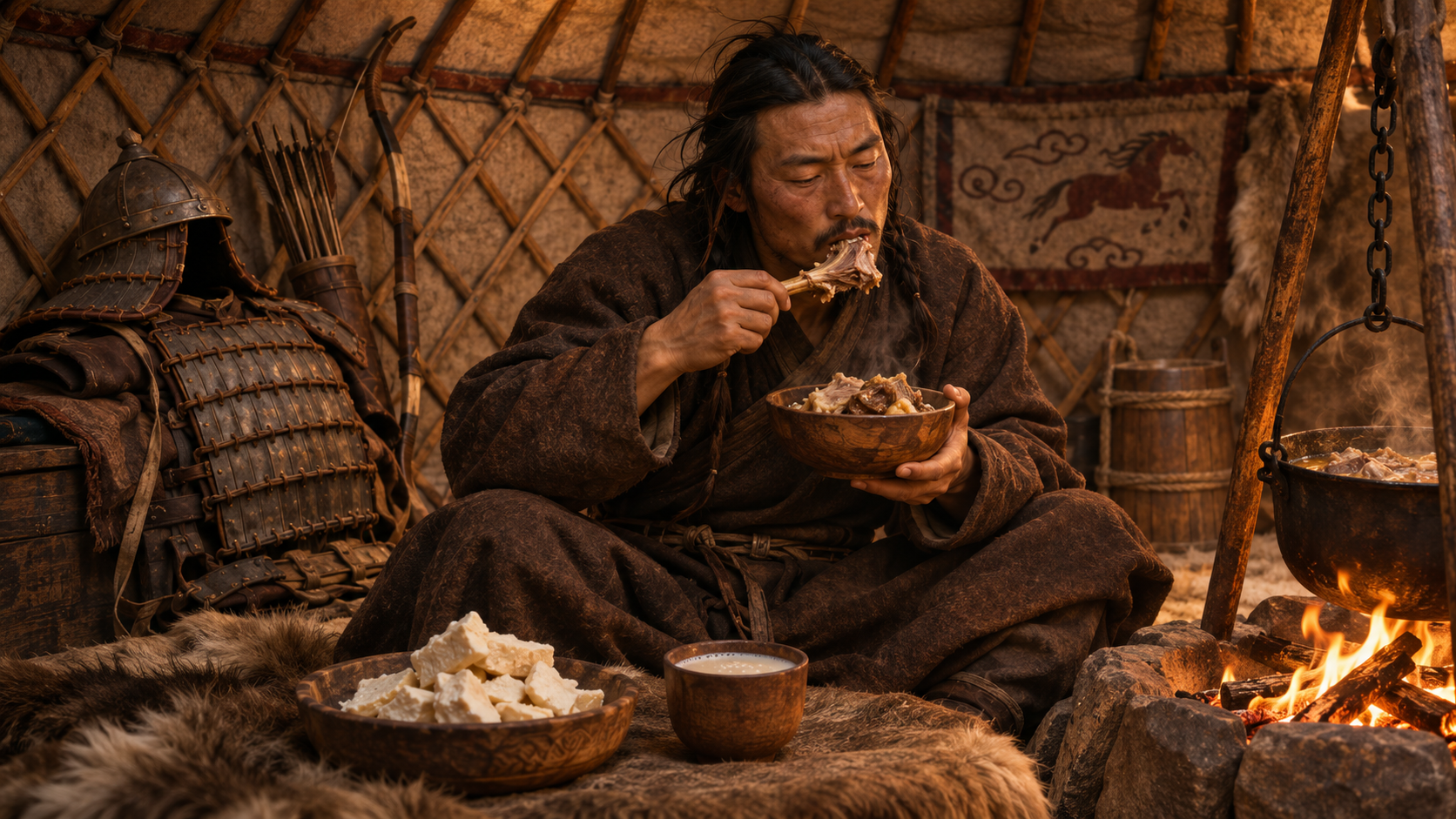
Mutton makes sense for a hearthside scene in a society that kept sheep. Dairy was also important. William of Rubruck, who travelled through the Mongol Empire in the 1250s, described meat, fermented mare’s milk and preserved curds. His account is from a generation after our card’s setting and gives a traveller’s view of the foods people prepared and served. What reached any rider’s bowl depended on season, livestock and where he was campaigning. Read William of Rubruck’s account
What did Mongol warriors believe?
Genghis Khan and his successors drew on the authority of Eternal Heaven, often called Tengri, in explaining their right to rule. The empire also encompassed people and communities with different religious traditions. The language used by a khan tells us about imperial authority. An ordinary rider’s private beliefs are much harder to recover. Cambridge on Eternal Heaven and Mongol rule
What was his mindset? The campaigns could be devastating to the people in their path, and Mongol armies also relied on discipline, trust and cooperation between riders. Those realities can coexist. We can describe what an army did and what it demanded of a veteran. How this particular man felt about an enemy or behaved around his family belongs to the reconstruction. Cambridge on captives and encounters in the early empire
Genghis Khan, the man behind the empire
Genghis Khan, also written Chinggis Khan, was born Temüjin. He brought rival steppe groups under his rule, founded the Mongol Empire in 1206 and died in 1227. By 1230, a veteran might already have served in one of his campaigns and now been riding under Ögedei. That is the connection between the most famous Mongol ruler and the imagined rider on Card 003. Read the Genghis Khan biography at Britannica
Explore the Lords of Showdown card collection · Card 001 · The Samurai · Card 002 · The Viking