

Lords of Showdown · Card 002 · Blades & Bows
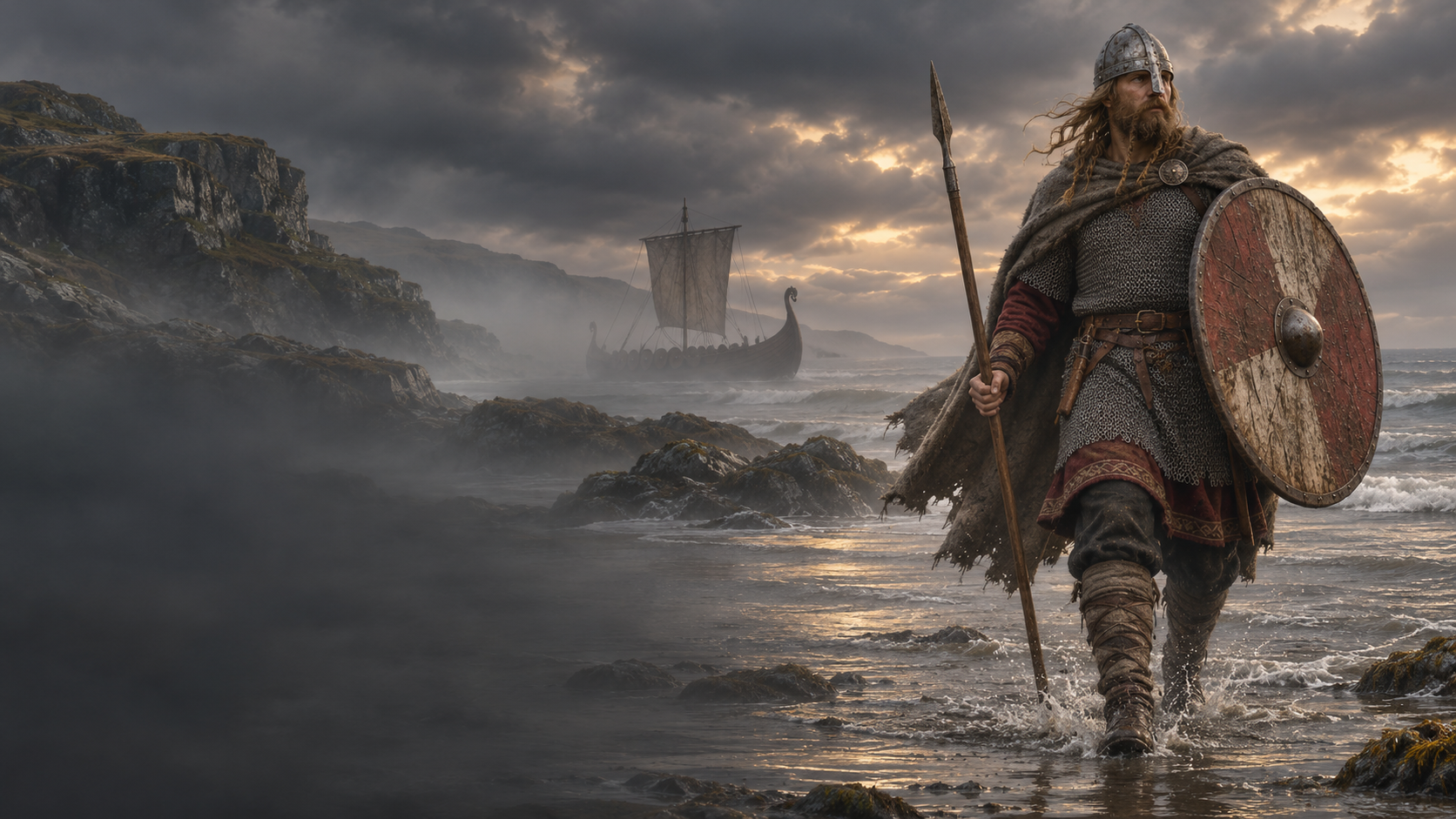
The longship is behind him. The spear and shield go ashore with him.
Put a spear in one hand and a round shield in the other. How do you keep an opponent at a distance without exposing yourself? Card 002 follows an imagined Norwegian veteran around AD 950, from the kit he carries ashore to the skills that get his crew home.
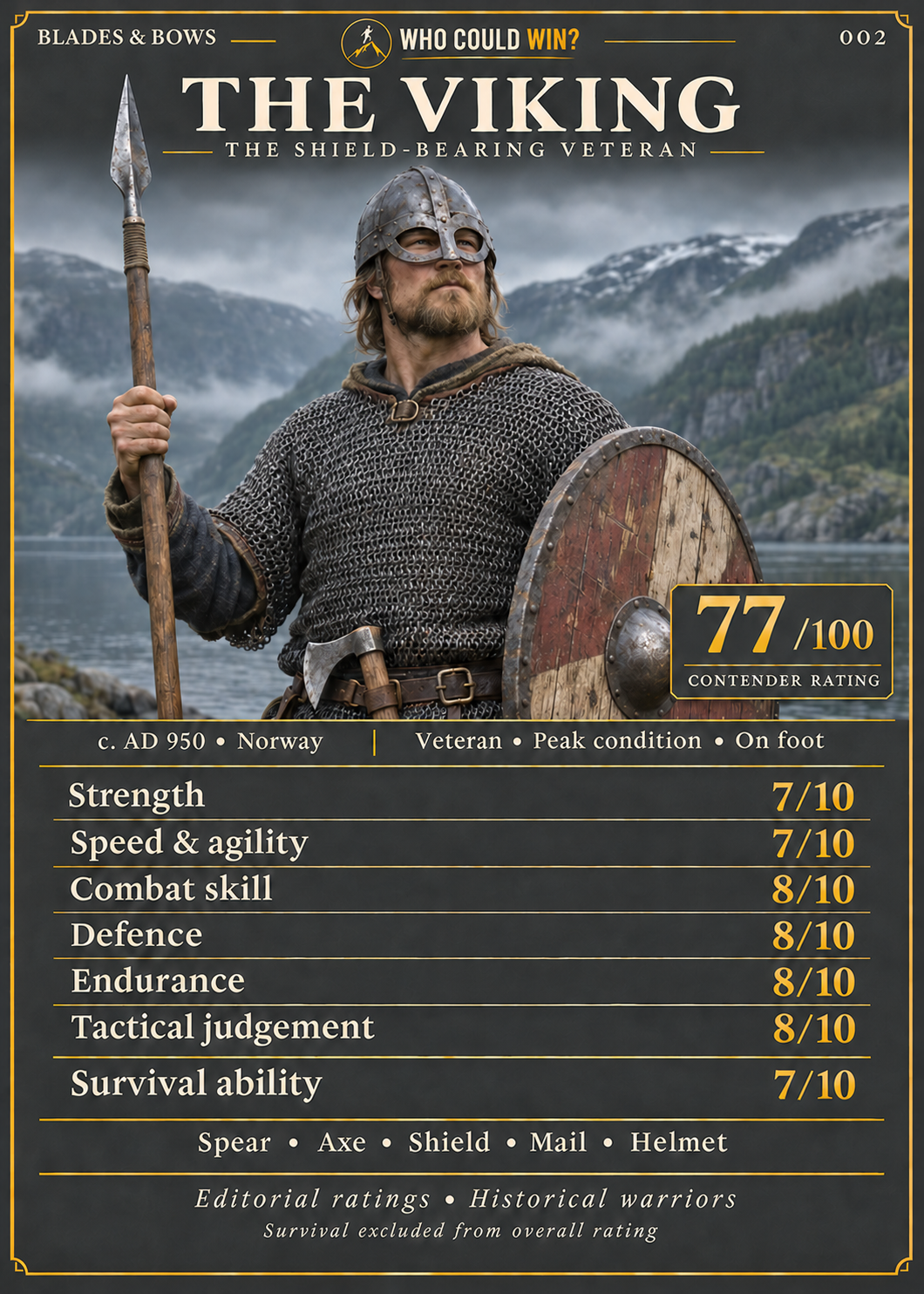
- Setting
- Norway, c. AD 950
- Role
- Veteran fighting on foot
- Card equipment
- Spear, axe, shield, mail and helmet
- Contender rating
- 77/100 · editorial
- Card ratings
- Strength 7, speed and agility 7, combat skill 8, defence 8, endurance 8 and tactical judgement 8 (all out of 10).
- Survival ability
- 7/10 · scored separately
What was the Viking world like around AD 950?
Raiding was one way to make a voyage pay. It took a ship, a crew and enough resources to get them out and back. Trade was another part of the same seafaring world. Towns such as Ribe connected Scandinavian merchants to wider networks. Our veteran is an imagined participant in that world, with an expedition behind him and a household to return to. The National Museum of Denmark on Viking expeditions · Viking Age trade
How tall were Vikings on average?
The National Museum of Denmark puts Viking Age men in its skeletal evidence at about 172 cm (5 ft 8 in) and adult women at about 160 cm (5 ft 3 in). These are estimates from Danish finds. They give us a point of comparison for Card 002, whose individual height is unspecified, and leave open how much stature varied across Viking Age Scandinavia. See the museum’s evidence on Viking appearance
What was the weather like in Viking Age Norway?
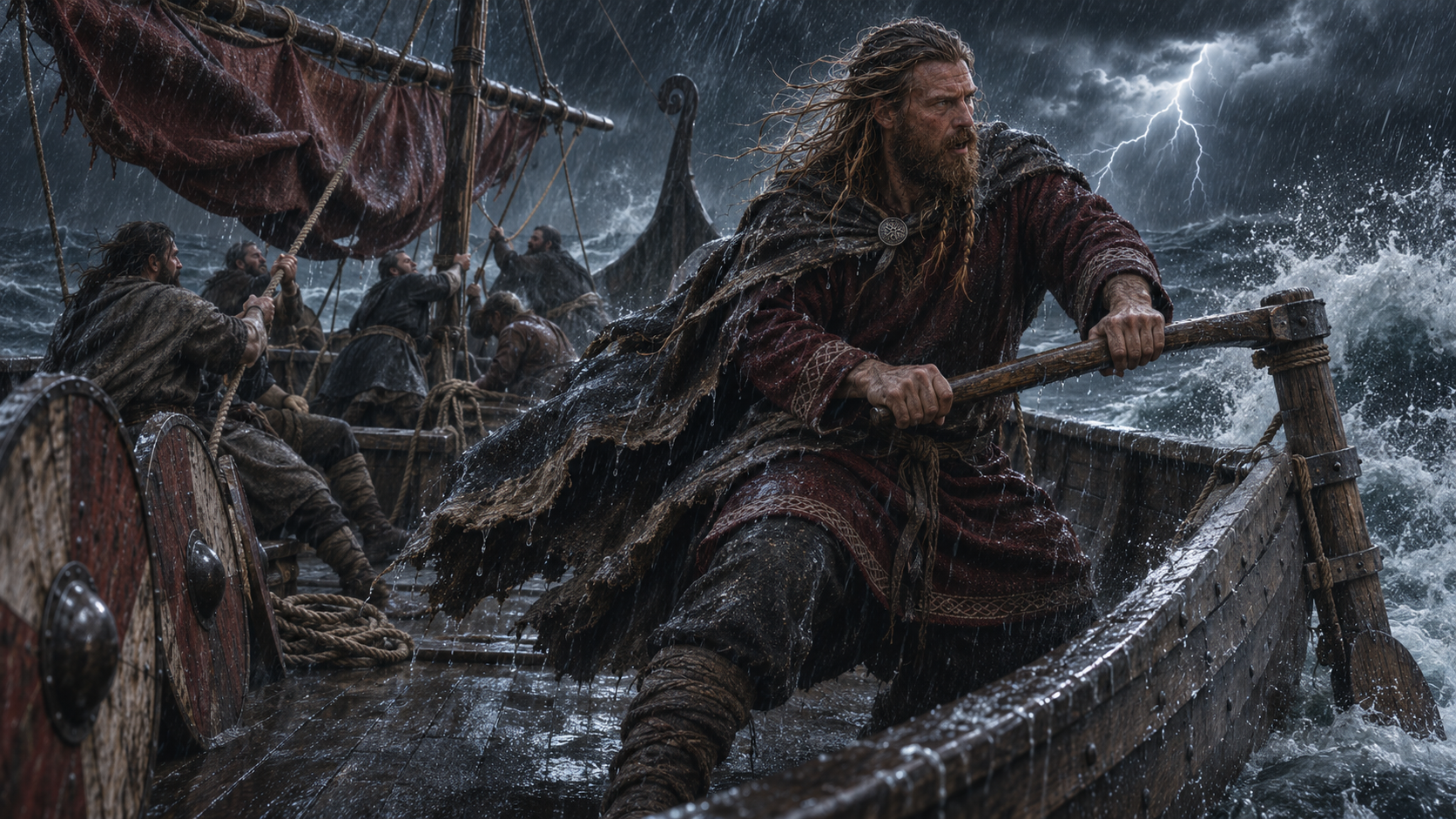
For a crew leaving Norway’s Atlantic coast, an exposed crossing could mean cold spray, strong winds and rough seas. A sheltered fjord could offer very different conditions on the same day. Norway’s mountains and long coastline produce sharp regional contrasts, and the ocean moderates coastal temperatures. Norway’s government on regional climate
Researchers use evidence such as lake sediments and tree rings to reconstruct broad climate patterns. The storm below is an imagined scene. The evidence describes regional climate across years and centuries, with little to say about conditions on any particular voyage around AD 950. Read the research on past climate in southeastern Norway
Viking weapons, shields and armour
Spear and shield. The spear lets our veteran threaten an opponent before they can reach him with a shorter weapon. A round shield gives him cover as he moves. The raised metal boss protects the hand holding the grip behind it. The axe gives this fighter a shorter option if he loses the space to use the spear.
Mail and helmet. Card 002 depicts a veteran equipped with both. Equipment varied with wealth, and surviving helmets and mail are rare. The hero’s hornless helmet is an interpretation. For the evidence behind Viking armour, look at what archaeologists actually recover. Explore Viking weapons and armour · See Viking shield evidence
How did Vikings steer and navigate their ships?
Steering. The helmsman worked a tiller connected to a rudder mounted on the starboard side near the stern. The Viking Ship Museum’s Gokstad boat reconstruction shows how a projecting wooden boss and a flexible fastening held the rudder against the hull. The ship and crew in our storm scene are imagined. See the museum’s Gokstad rudder reconstruction
Navigation. Knowing the coast, watching the sun when visible and reading the conditions could all help a crew find its way. Norse seafarers reached what is now Newfoundland, where the remains at L’Anse aux Meadows give us physical evidence of their presence. Which navigation instruments they relied on is still debated. The Viking Ship Museum on navigation instruments · Parks Canada on L’Anse aux Meadows
What did Vikings eat?
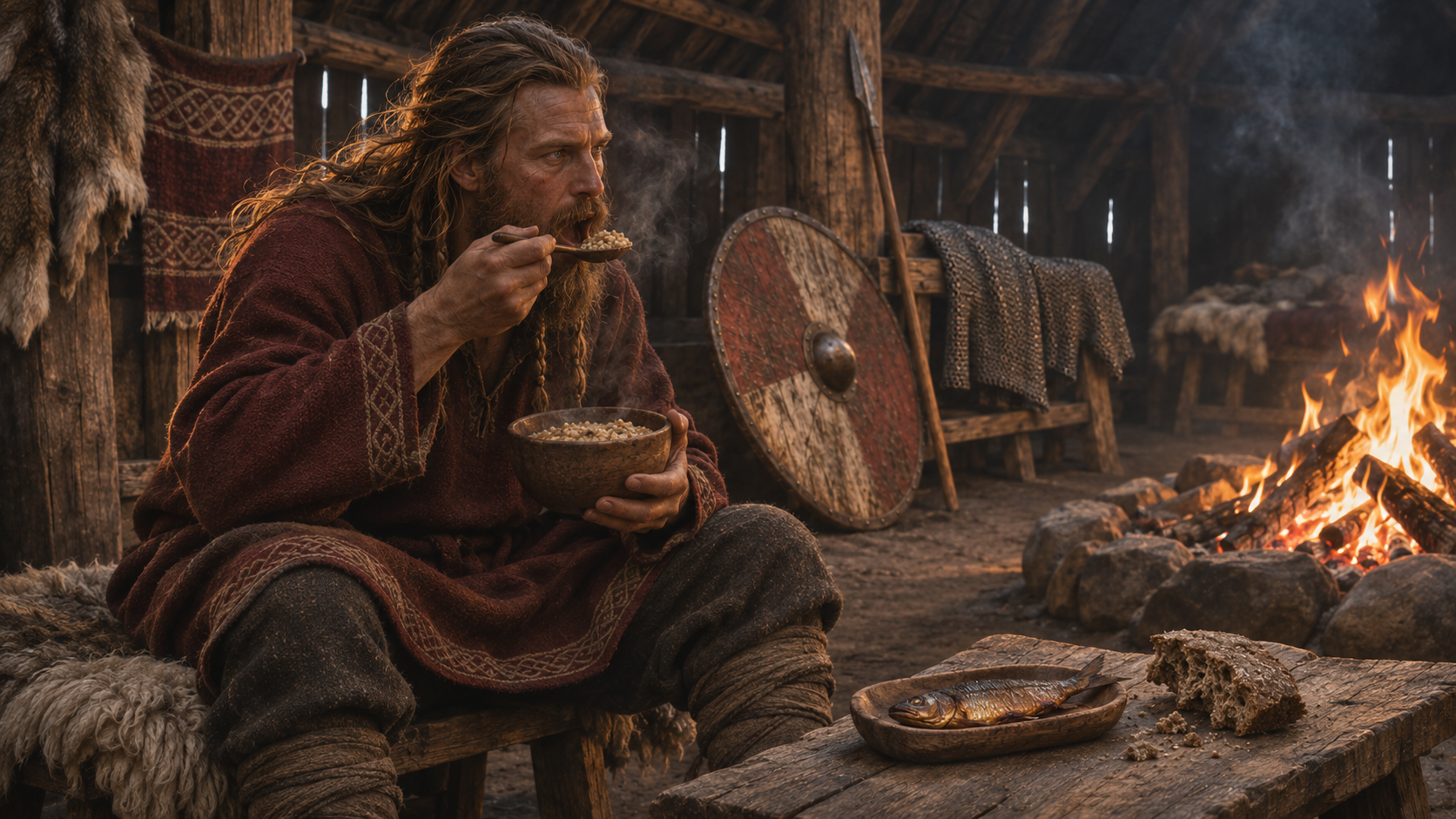
Barley porridge, smoked herring and coarse rye bread make a plausible meal for this coastal scene. The National Museum of Denmark describes cereals, fish, meat, vegetables and dairy in Viking Age diets. Archaeologists can use plant remains and animal bones to learn what people ate. What was available in any one household depended on place, season and means. Explore Viking Age food evidence · Bread and porridge
Famous Viking · Leif Erikson
Leif Erikson, also spelled Leif Eriksson, is remembered in the Norse sagas for voyages to Vinland around AD 1000, about half a century after our card’s setting. The archaeological site at L’Anse aux Meadows confirms a Norse presence in Newfoundland. Parks Canada describes the link to Leif’s own camp as possible. Read Leif Eriksson’s biography at Oxford Academic · Explore the site with Parks Canada
The scene illustrations are AI-assisted depictions of an imagined warrior.
Explore the Lords of Showdown card collection · Read Card 001 · The Samurai