

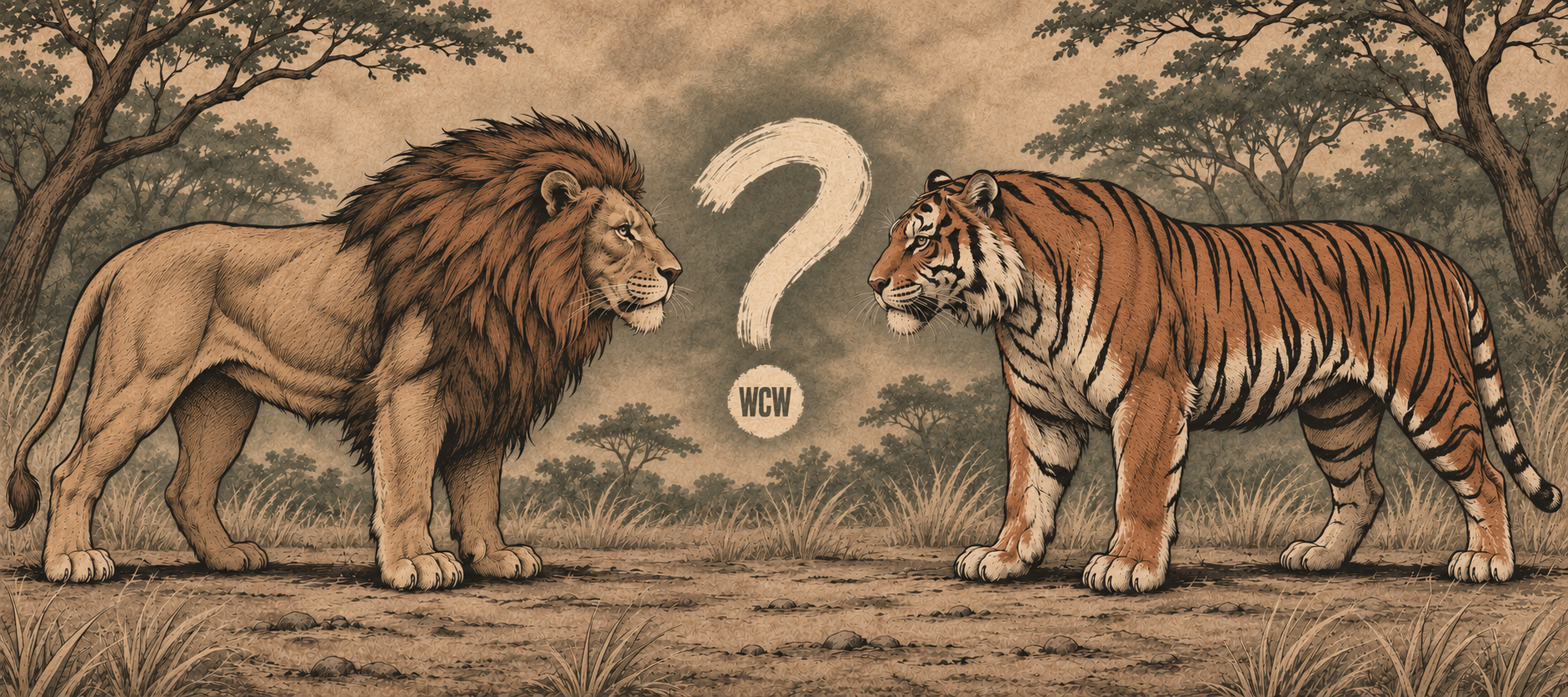
Who has the edge, the lion or the tiger?
A slight edge to the Bengal tiger in this matchup. We’ve chosen a 220 kg tiger and a 190 kg African lion, both healthy adult males. Their published weight ranges overlap. On open ground, both see each other coming, and either could gain the upper hand.
What gives each cat an edge?
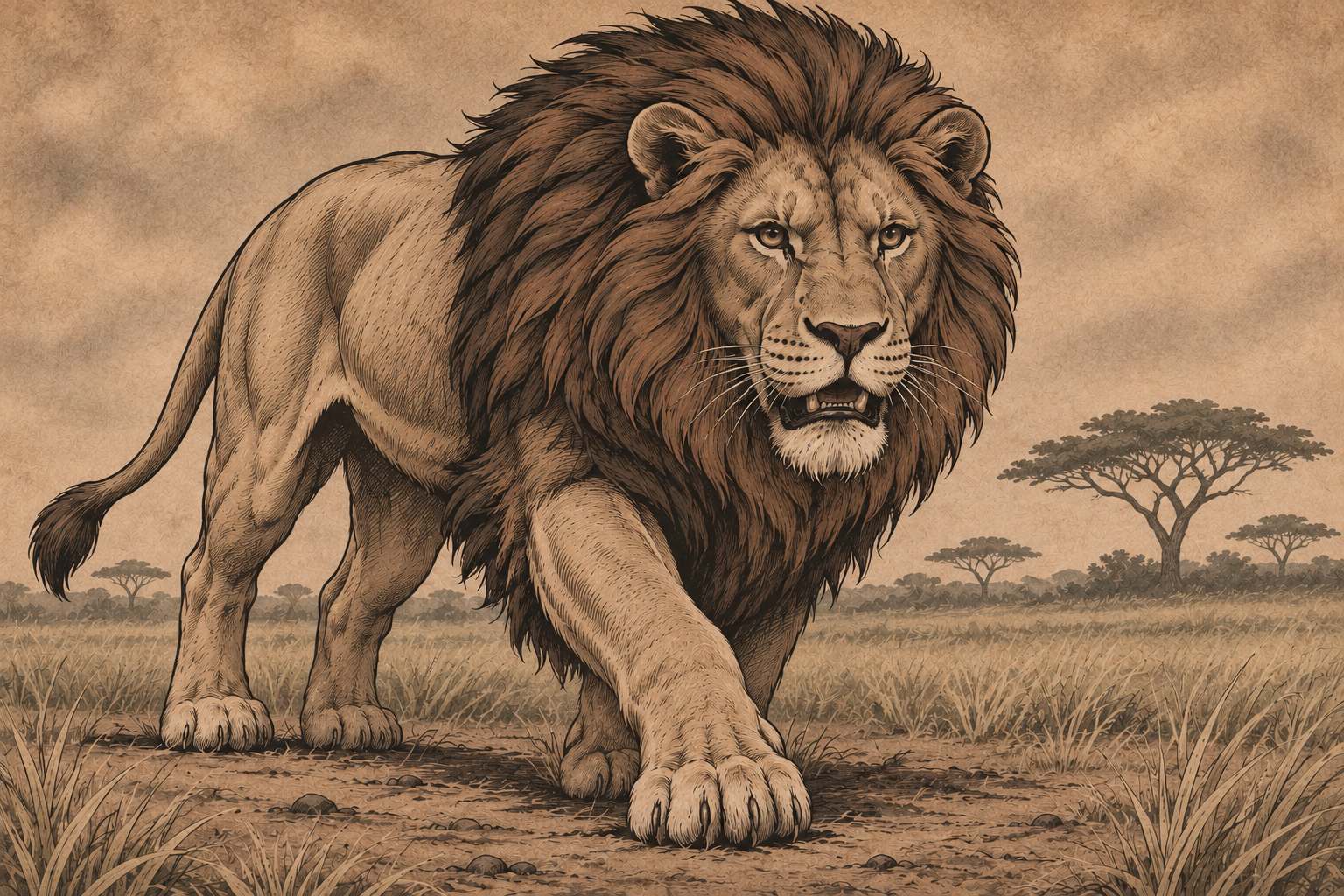
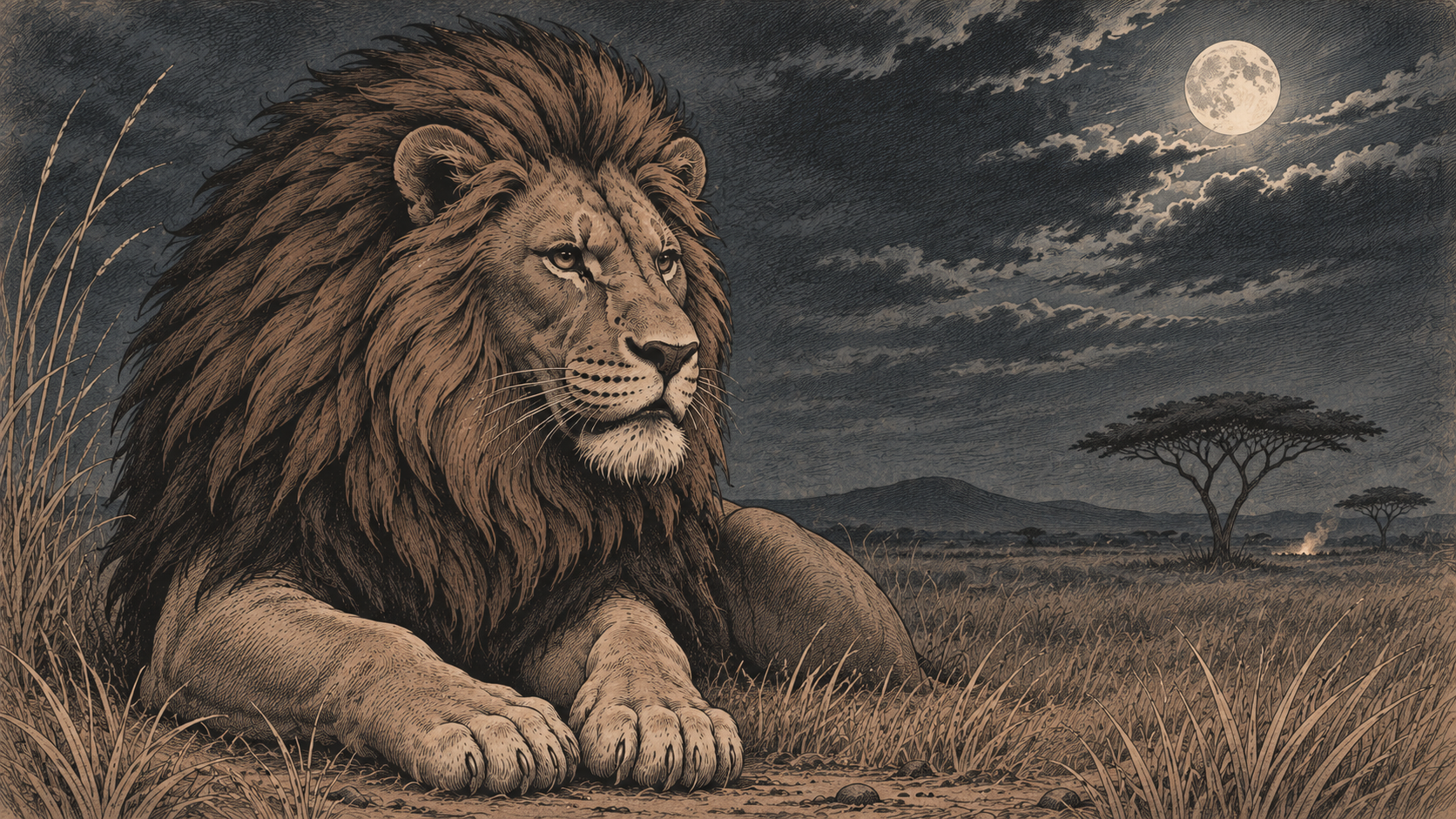
The African lion
Male lions can defend territory and access to prides, often alongside coalition partners. For this encounter, our lion is alone.
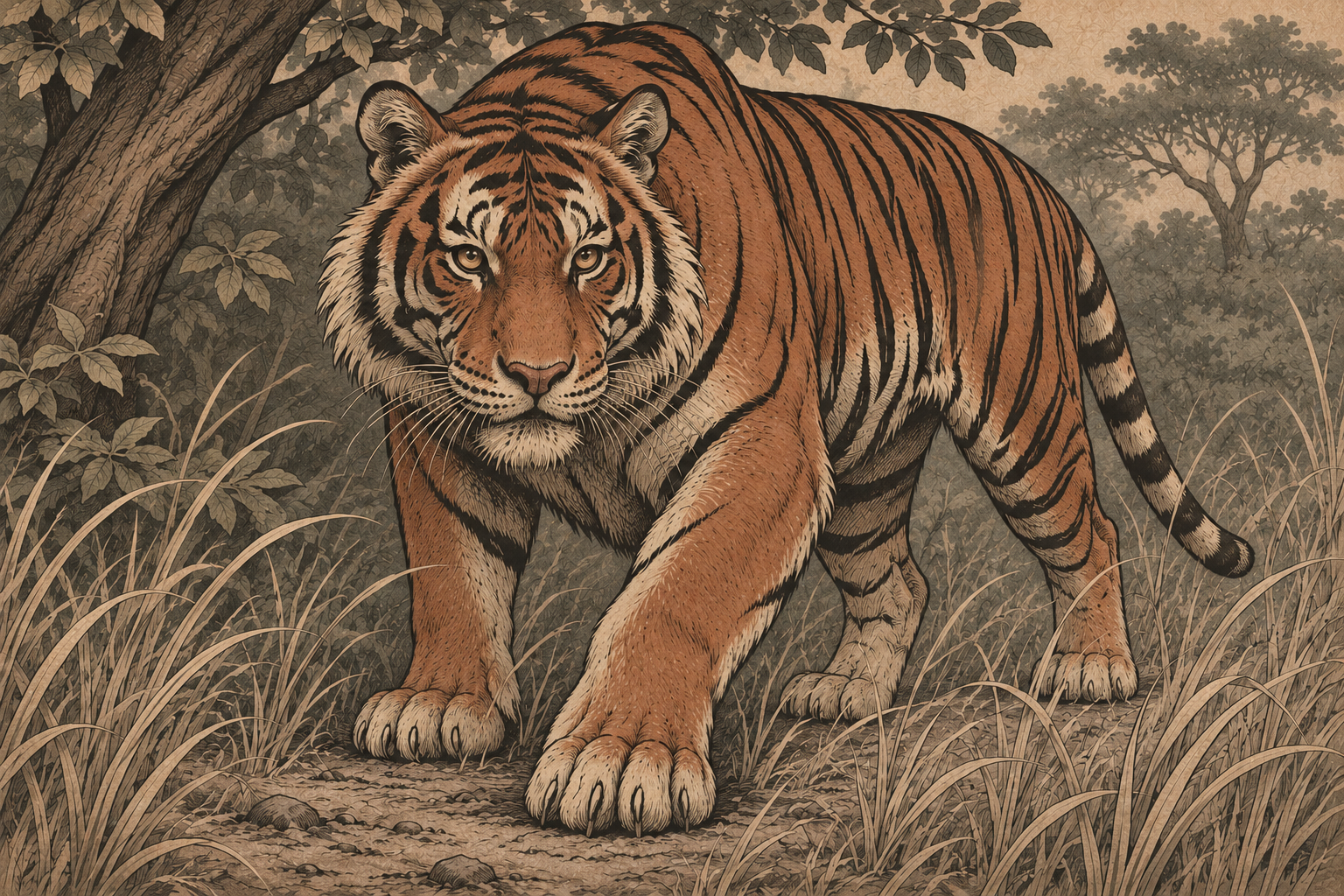
The Bengal tiger
Tigers usually stalk and ambush prey alone. For this encounter, the tiger starts in full view, with a weight advantage.
Smithsonian National Zoo lion profile · San Diego Zoo Wildlife Alliance tiger profile
What happens in the first clash?
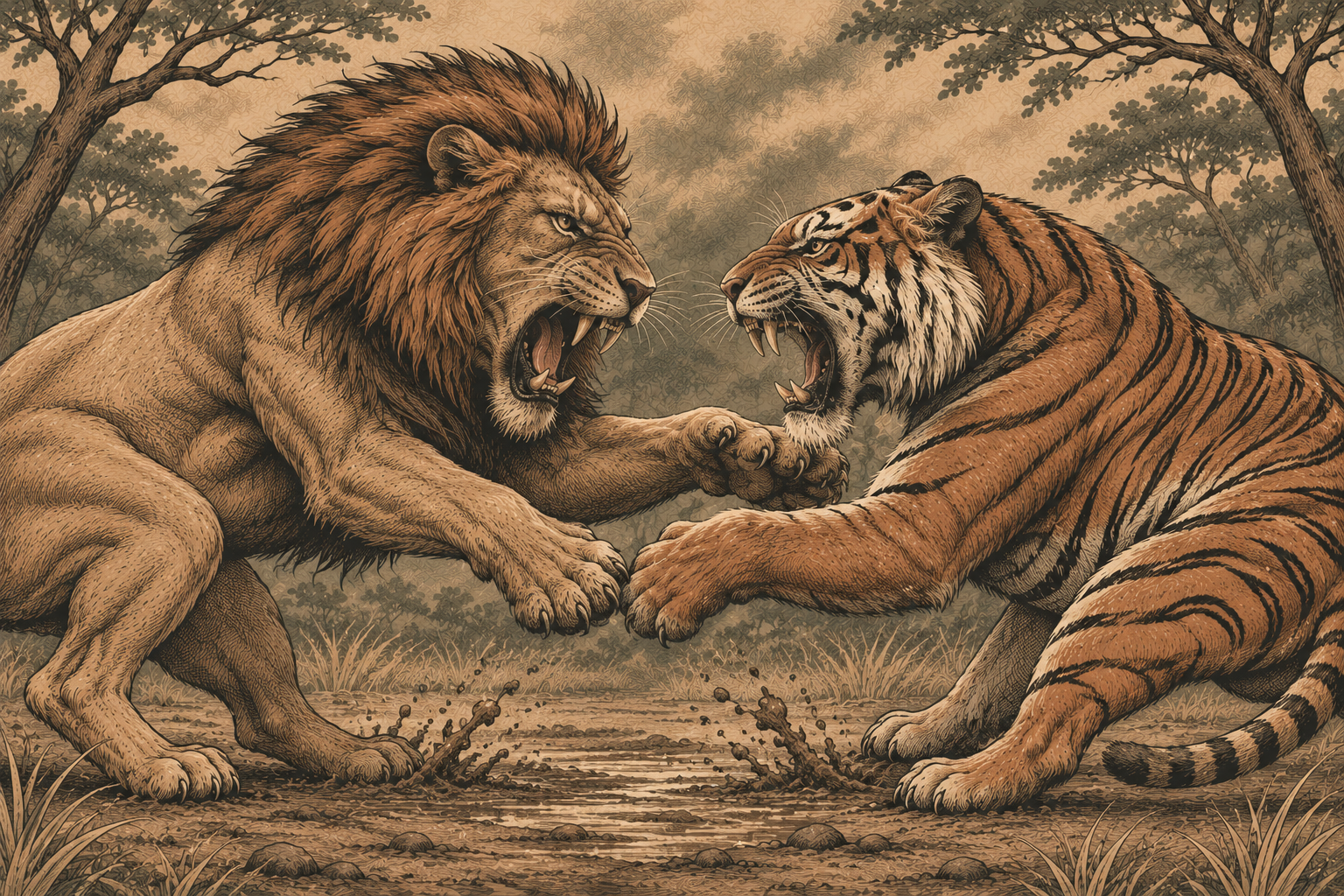
In our imagined fight, the lion squares up and the tiger shifts sideways. They close the gap in two strides. Both twist away from the other’s jaws, and neither gets a clean grip.
Which is bigger, a lion or a tiger?
Large male Bengal tigers can outweigh many male African lions, but the published weight ranges overlap. Length figures also depend on whether the measurement includes the tail. Body mass is the clearest comparison for this matchup.
San Diego Zoo Wildlife Alliance lion measurements · Central Zoo Authority Bengal tiger studbook, Table 1 · Smuts and colleagues’ wild Kruger lion measurements
What countries and regions do lions and tigers live in?
Lions. Wild populations survive in parts of sub-Saharan Africa, including savannas, grasslands and open woodland. The remaining wild Asiatic lions live in Gujarat, India, in and beyond the Gir landscape.
What countries have resident wild lions?
The 2025 IUCN assessment lists Angola, Benin, Botswana, Cameroon, Central African Republic, Chad, Democratic Republic of the Congo, Ethiopia, India, Kenya, Mozambique, Namibia, Senegal, South Africa, South Sudan, Sudan, Tanzania, Uganda, Zambia and Zimbabwe as having native resident lions. It lists resident reintroduced populations in Malawi and Rwanda.
Tigers. The IUCN Cat Specialist Group lists wild populations in Bangladesh, Bhutan, China, India, Indonesia (Sumatra), Malaysia, Myanmar, Nepal, Russia and Thailand. Bengal tigers occur in India, Bangladesh, Bhutan and Nepal.
IUCN Red List lion assessment, 2025 · IUCN Cat Specialist Group tiger range · Gujarat Forest Department lion census, 2025
Have lions and tigers ever met in the wild?
Their historical ranges overlapped in parts of India, where the lion was Asiatic. A published review collects nineteenth-century accounts of encounters, which vary in quality. Captive clashes have also been reported, including at Ankara Zoo in 2011. These reports tell us an encounter can happen. They cannot establish how often either cat would win.
India has both species today. A February 2026 parliamentary answer reported a tiger in Gujarat’s Ratanmahal Wildlife Sanctuary, in a different landscape from the state’s main lion populations. Shared state boundaries don’t establish an encounter. The African lion and Bengal tiger in our scenario live on different continents.
Historical accounts in the Journal of the Bombay Natural History Society · BBC report on the 2011 captive encounter · Indian parliamentary answer on the Gujarat tiger, February 2026 · Gujarat Forest Department lion census, 2025
What do lions and tigers mainly hunt?
What is a lion’s main prey?
African lions often hunt medium and large hoofed animals. A review found preferences for wildebeest, zebra, buffalo, giraffe and gemsbok across its study sites. What dominates the diet varies locally.
What is a Bengal tiger’s main prey?
Deer and wild pigs are important prey. A review across Bengal tiger landscapes identified chital, sambar, wild boar and northern red muntjac as important prey, with the mix changing by habitat and availability.
How do lions and tigers compare for speed and stamina?
What does the evidence say about speed?
GPS collars have measured wild lions accelerating, braking and turning during hunts. That study did not include tigers. A tiger’s ambush uses a short burst, but the available sources don’t give us a comparable maximum-speed test. For a clash only a few metres apart, the first step, balance and ability to turn matter more than top speed.
What does the evidence say about stamina?
Travelling a long way and sustaining a close struggle are different demands. The evidence here does not rank the two cats for endurance in a fight. Starting fatigue, heat, injury and how hard either has already exerted itself could change the exchange.
Wilson and colleagues’ GPS study in Nature · San Diego Zoo Wildlife Alliance tiger profile
What difference would jaws, claws and fur make?
Does a lion or a tiger have the stronger bite?
One skull-based model estimated about 1,768 newtons for its lion sample and 1,525 for its tiger sample at the canines. The lion sample had the higher estimated body mass. After adjustment for body size, the tiger scored higher on that study’s bite-force quotient, 127 versus 112. Those are model estimates and relative scores. Neither tells us which of our two animals would deliver the stronger bite in this fight.
Wroe and colleagues’ bite-force study, Table 1
What makes their claws dangerous?
Both cats can use their hooked claws and forelimbs to grab and hold. A claw length tells you little about how hard an animal can strike or how well it can hold another big cat. The sources here provide no like-for-like measurements of claw or paw-strike force.
Smithsonian National Zoo lion profile · San Diego Zoo Wildlife Alliance tiger profile
Which has thicker fur, and does a lion’s mane help?
A male lion’s mane adds conspicuous hair around the head, neck and shoulders. An Amur tiger has a thicker cold-weather coat than other tiger populations, but our tiger is Bengal. A study of African lion wounds found no compelling evidence that manes offered effective protection from wounding. Comparable coat-thickness data for our two chosen cats are lacking.
West and colleagues’ study of lion manes and wounds · ZSL Amur tiger profile
How might each cat react to the other?
How might the tiger react to the lion?
The tiger might hesitate, hold its ground or give way. Its solitary hunting habits do not tell us how it would respond to an unfamiliar adult lion facing it directly.
How might the lion react to the tiger?
The lion might display, approach or retreat. Familiarity with rival lions gives us some context, but an unfamiliar tiger presents a different situation. A roar or a retreat alone cannot tell us what either animal feels.
How hungry, injured or cornered each cat is could change what happens. Serengeti playback experiments showed female lions adjusted their approach to the apparent number of intruders. That supports the idea that context matters, while leaving the response of these two males open.
McComb and colleagues’ lion playback experiment
How would cover and experience change the encounter?
Dense cover could let either cat approach unseen, especially a tiger using its usual stalking tactics. Open ground removes that opportunity in our setup. Prior fights and individual condition could matter as much as the setting. A pride or coalition would change the matchup entirely.
Smithsonian National Zoo lion profile · San Diego Zoo Wildlife Alliance tiger profile
How could the lion vs tiger fight unfold?
The setup. A healthy 190 kg adult male African lion meets a healthy 220 kg adult male Bengal tiger on firm, open ground at a woodland edge. They start several metres apart, aware of each other. Each has room to retreat.
How could the tiger gain the upper hand?
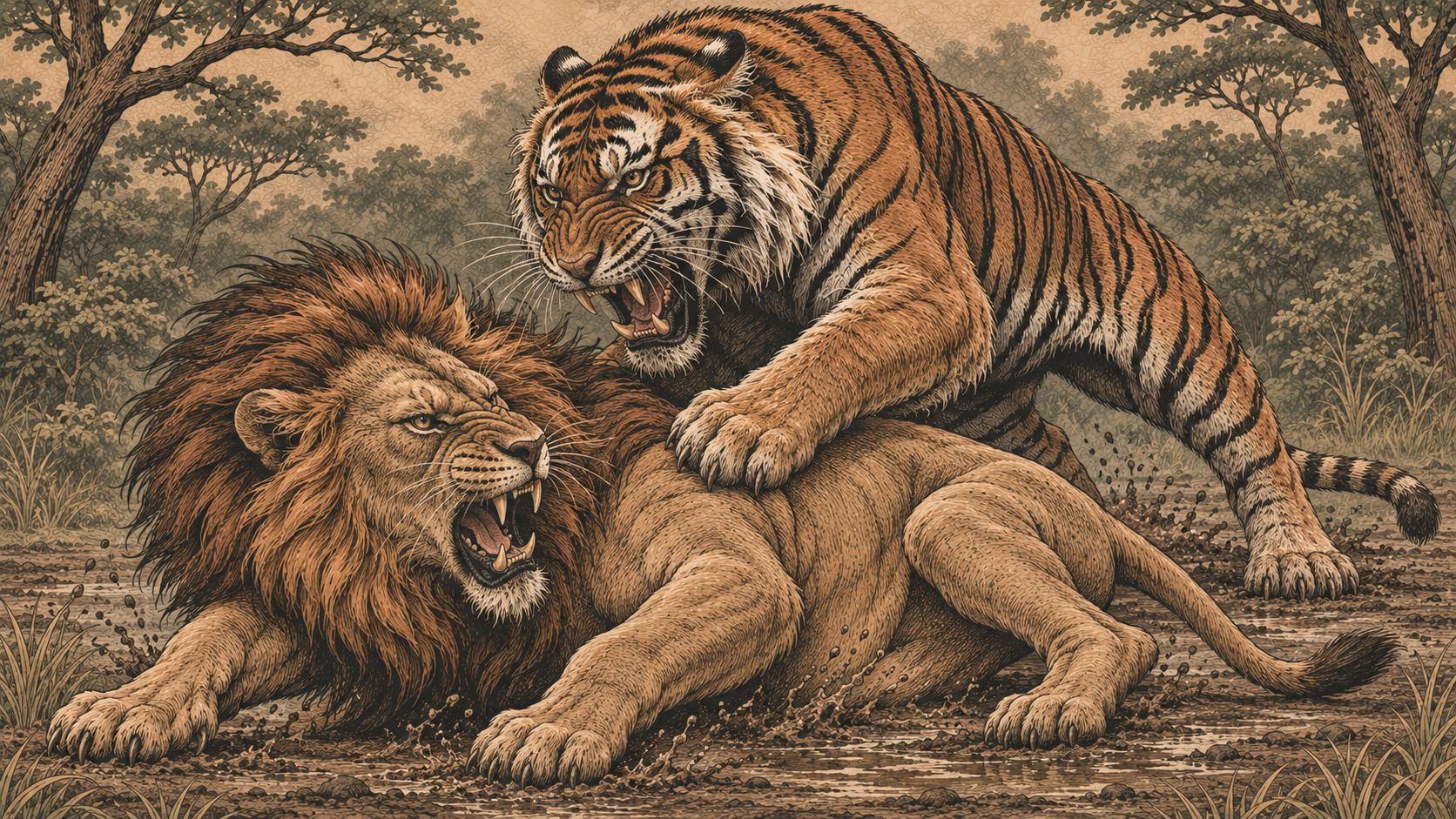
The tiger steps across the lion’s line and gets a forepaw over his shoulder. The lion goes down on one side and scrambles for footing. With its weight above the lion, the tiger has the better position in this exchange.
How could the lion turn it around?
If the lion keeps his feet and meets the tiger squarely, the tiger may never get to the shoulder. The lion could force it back or create space to disengage. Either cat could back away before the struggle becomes prolonged.
Illustrated fiction based on the stated setup.
Why does the tiger get a slight edge?
Bengal tiger, with a slight edge. The clearest advantage is the 30 kg we assigned it. Extra mass could matter if the cats get locked in a struggle for position. At equal weight, or with a heavier lion, the case for the tiger weakens. The verdict is an editorial judgement with limited confidence.