

One specialist.
A living swarm.
Giant anteater vs army ants. The most important advantage may be the simplest: the freedom to leave.
Size meets numbers.
Behaviour decides the story.
A feeding specialist and a colony of predators do not need to fight until one side is destroyed.
 CONTENDER 01 / THE SPECIALIST
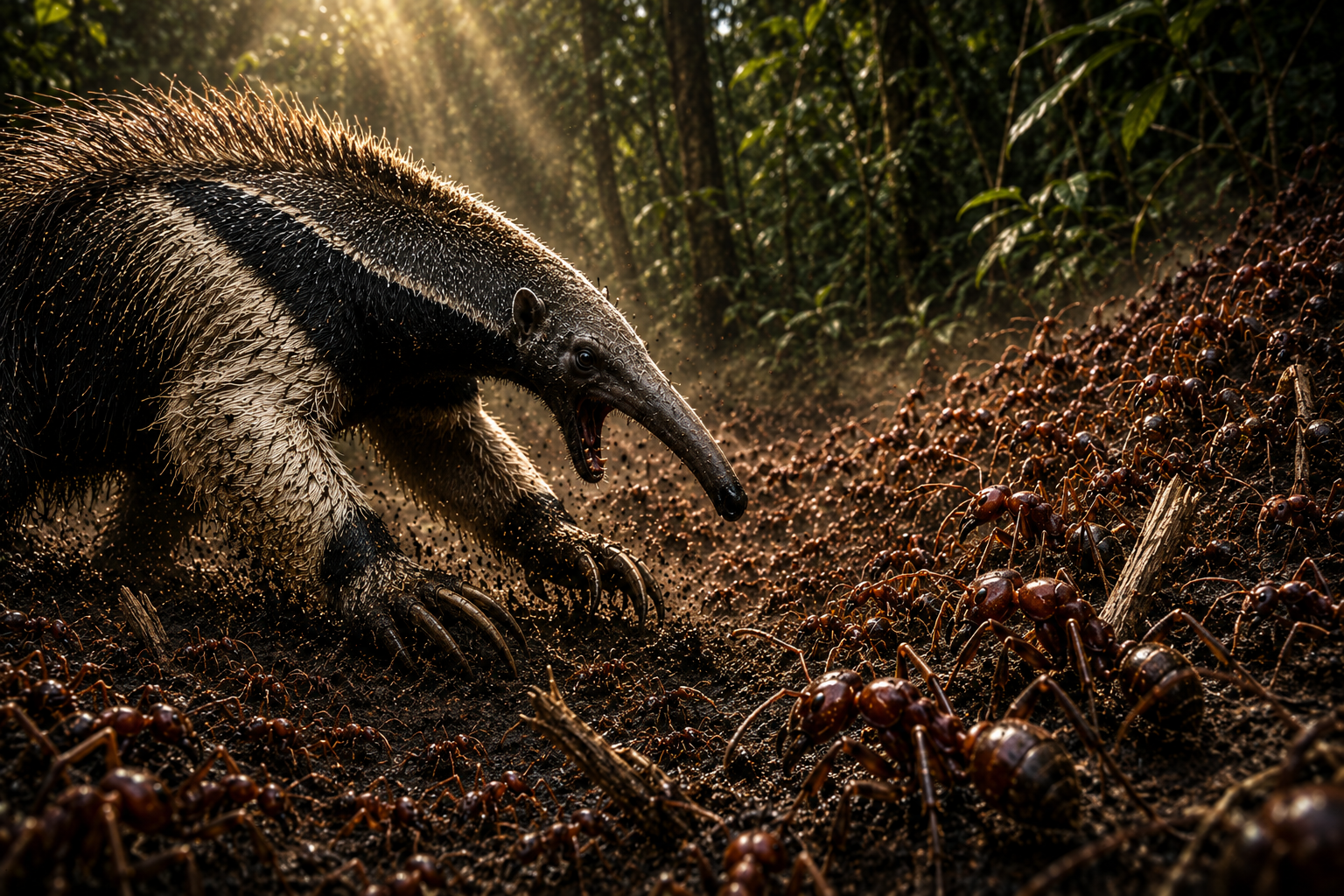
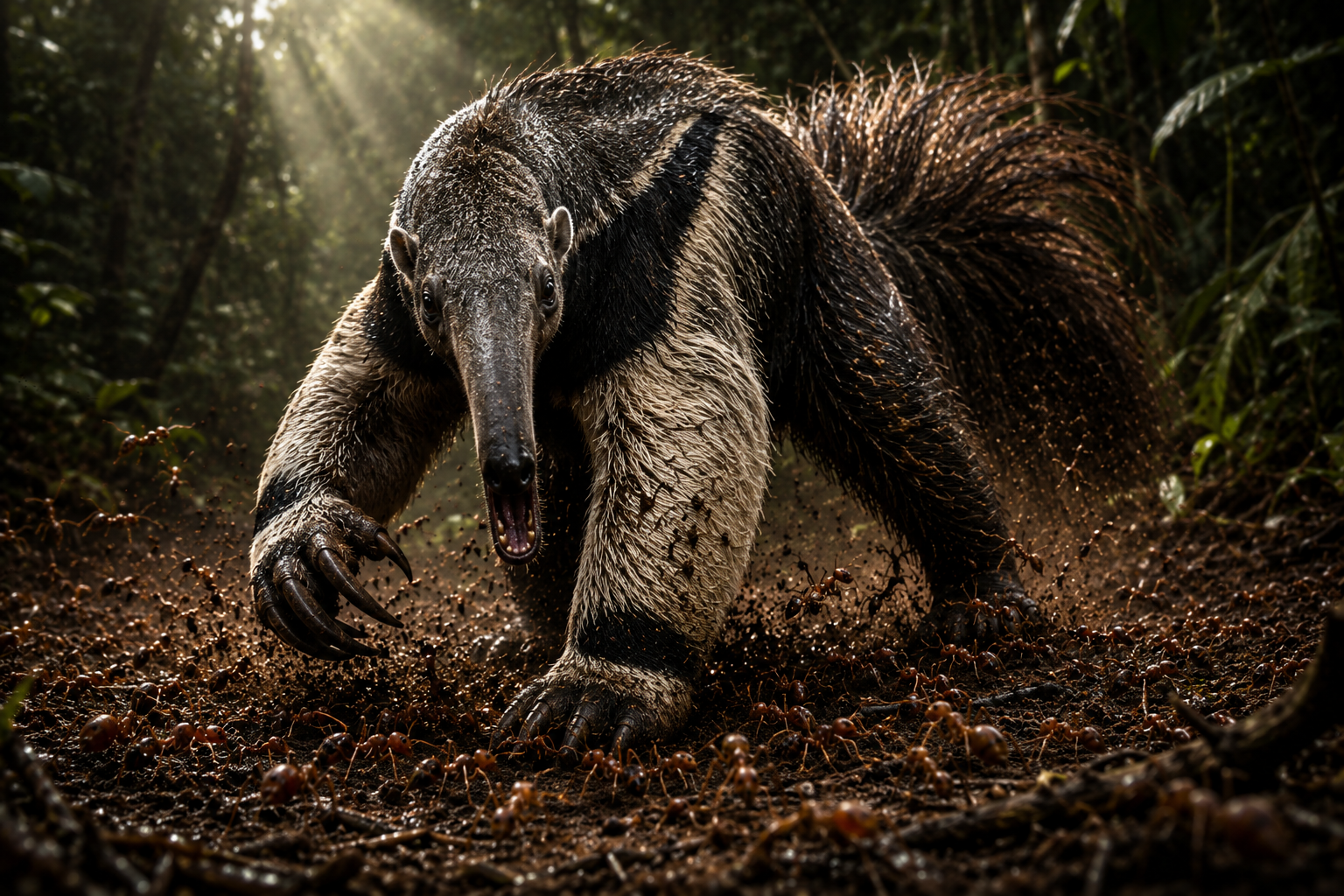
Giant Anteater
A mammal specialised for feeding on ants and termites. Its claws open nests; its long, sticky tongue collects the insects. Feeding does not require eliminating an entire colony.
 CONTENDER 02 / THE COLONY
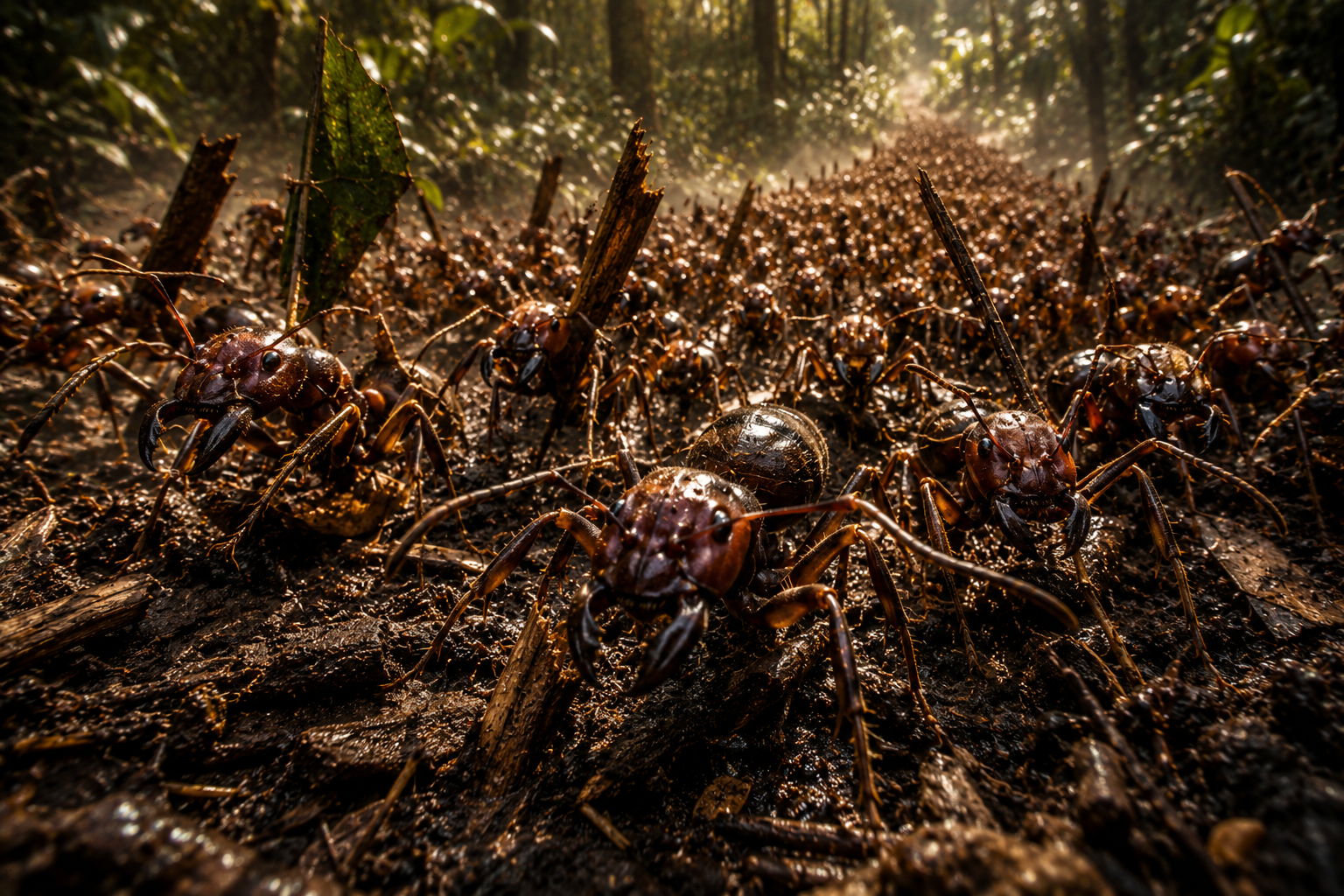
The Marching Ants
A coordinated raiding colony, using the Neotropical species Eciton burchellii as our biological reference. Army ants are diverse; one dramatic image cannot represent every species or colony.
Images illustrate the scenario and are not photographs or evidence of a documented encounter. No exact colony size or worker measurements are assumed.
One animal.
Many small opponents.
Comparing an individual with a colony requires more than counting attribute wins.
| Factor | Anteater | Army ants |
|---|---|---|
| Scale | One large mammal. | Many small workers. |
| Feeding tools | Claws and sticky tongue. | Mandibles and collective prey handling. |
| Movement | Can move away in this scenario. | A raid moves through the environment. |
| Exposure | Contact can be limited by leaving. | Effects depend on contact and duration. |
| What matters | Maintaining mobility. | Species, worker numbers and access. |
Four moments.
No endless battle.
An imagined sequence exploring the conditions—not a reconstruction or tested simulation.
A moving trail.
A choice to make.
The anteater approaches a busy patch of forest floor. In this story, it encounters a raid rather than a nest. Nothing in the setup requires it to stay.
Tools for feeding.
No instant wipeout.
The anteater disturbs the surface and investigates. We do not assume each sweep kills thousands of ants or that claws can destroy a colony spread across the ground.
Contact has
a cost.
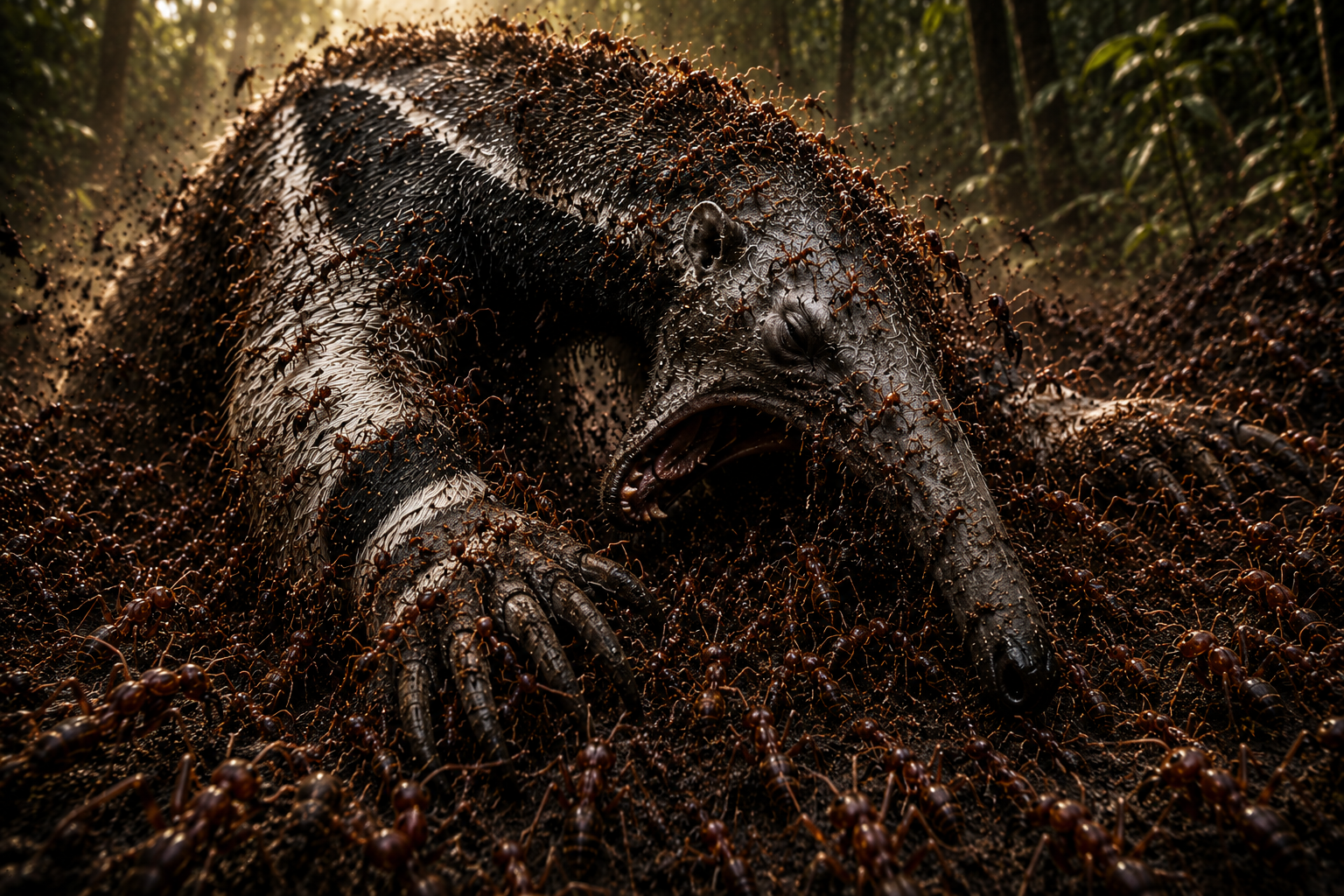
In the imagined scene, ants climb onto the animal. Continued contact could increase irritation or injury, but the illustration cannot establish severity or predict a fatal outcome.
The encounter
can simply end.
The anteater moves away. Under our rules, leaving the raid is a successful outcome. It does not mean the colony has been defeated or destroyed.
Our pick: the anteater.
Because it can leave.
For a healthy, mobile adult with a clear route away, we favour survival. The animal does not need to overpower the whole colony. This is an editorial judgement about the stated encounter, not a measured survival rate.
Withdrawal available.
Our selected outcome is an anteater that moves away and survives. The ants continue their activity; neither side has to be annihilated.
A different question.
Removing escape changes the scenario. It could increase risk, but does not establish that the ants would kill it. Species, exposure and the animal’s condition would need evidence.
Could army ants kill a trapped anteater?
This comparison does not establish that outcome. We would need evidence for the specific ant species, number of workers, exposure duration and the anteater’s health. A hypothetical possibility is not a documented event.
Are all army ants the same?
No. The label covers different species and foraging patterns. We use Eciton burchellii as a reference rather than combine every army-ant characteristic into one imaginary super-colony.
Does eating ants guarantee immunity?
No. A specialised diet does not prove that every ant species is safe to encounter or that extended exposure cannot cause harm.
Is walking away really winning?
Yes, under this version’s rules: the question is whether the anteater survives. Destroying the colony would be a separate and much less useful victory condition.
Specialisation.
Not invincibility.
The biology is more interesting than a monster-swarm story.
A tongue does
the collecting.
The Smithsonian describes a long tongue coated in sticky saliva for collecting ants and termites. Claws help open nests, rather than functioning as an insect-sweeping weapon in a prolonged duel.
Cooperation
at a smaller scale.
Animal Diversity Web describes Eciton burchellii workers cooperating to subdue and carry prey. That collective ability does not support a claim that they overwhelm every animal in their path.
- Smithsonian’s National Zoo: Giant anteater — feeding tools, diet and natural history.
- Animal Diversity Web: Eciton burchellii — species-specific ecology, diet and cooperative foraging.
Sources support the biological background. The pictured encounter and survival verdict are speculative; no documented fatal attack or measured win rate is claimed.
Questions Readers Ask
The battle may be over, but there are still plenty of fascinating questions about anteaters, army ants and how these remarkable creatures behave in the wild.
Has An Army Ant Swarm Ever Killed A Large Mammal?
The stories are legendary.
Travellers’ tales, jungle folklore and countless documentaries have described army ants as unstoppable waves that can strip animals to the bone in minutes.
The reality is more nuanced.
Army ants are unquestionably among the most effective collective hunters on Earth. A single colony can contain hundreds of thousands, and sometimes millions, of individuals working together as a living superorganism. Researchers have documented army ant raids overwhelming insects, spiders, worms, reptiles, nestlings and other small animals caught in their path.
There are also reports of army ants killing tethered livestock, trapped animals and creatures unable to escape. However, documented cases involving healthy large mammals are extremely rare. Most experts consider stories of army ants routinely killing adult cattle, horses or humans to be exaggerated or dependent on the victim already being immobilised, injured or otherwise unable to flee.
One reason is simple: movement.
A healthy large mammal can usually walk, run or relocate long before the swarm can inflict life-threatening damage. Army ants are devastating against creatures that cannot escape. Against large mobile animals, they are far less effective.
This is why the anteater remains the favourite in our battle.
Despite being covered in ants, it retains something that most of the swarm’s victims do not:
The ability to leave.
Historical Reality
- Army ant swarms have been observed killing large worms, insects, reptiles and other small prey.
- Colonies can consume enormous numbers of prey animals during raids.
- Reports of human deaths are exceptionally rare and generally involve unusual circumstances rather than healthy adults being overwhelmed in open terrain.
- Most large mammals simply move away from advancing swarms.
WhoCouldWin Verdict
Army ants are one of nature’s most terrifying collective predators.
But their greatest victories usually come against creatures that cannot escape.
What’s Your Verdict?
We’ve delivered our verdict, but now it’s your turn. Would the giant anteater simply walk away from the swarm, or could millions of marching ants eventually bring down one of nature’s greatest insect hunters?
Did You Know?
Both of these challengers possess extraordinary abilities that make them some of nature’s most fascinating specialists.