

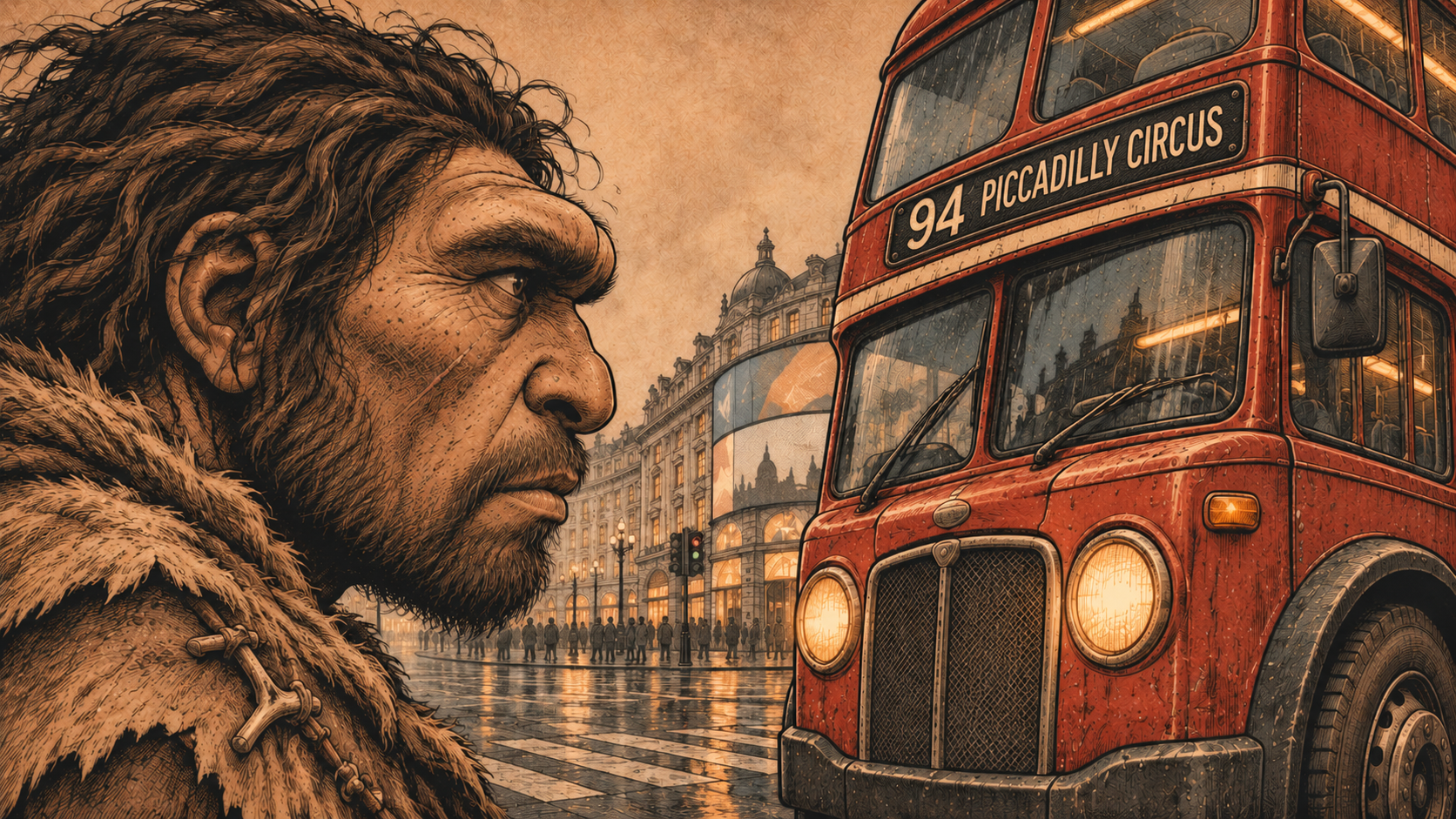
Could a Neanderthal
survive modern London?
He can read a landscape, make tools and survive a demanding environment. London offers food on every corner and shelter on every street. Could he learn how to reach either before the city overwhelms him?
Yes, with help.
Alone is another story.
Drop an ancient human into London and his first challenge is making himself understood. He has useful knowledge, but almost none of the shared habits that let a modern Londoner buy lunch, board a bus or ask for a room.
This experiment follows a healthy adult for one year. We judge survival with assistance as a success. That makes the response of the people around him central to the outcome.
Built to survive.
Starting from zero.
A year in London tests more than endurance. It tests access, trust and the ability to learn unfamiliar rules.
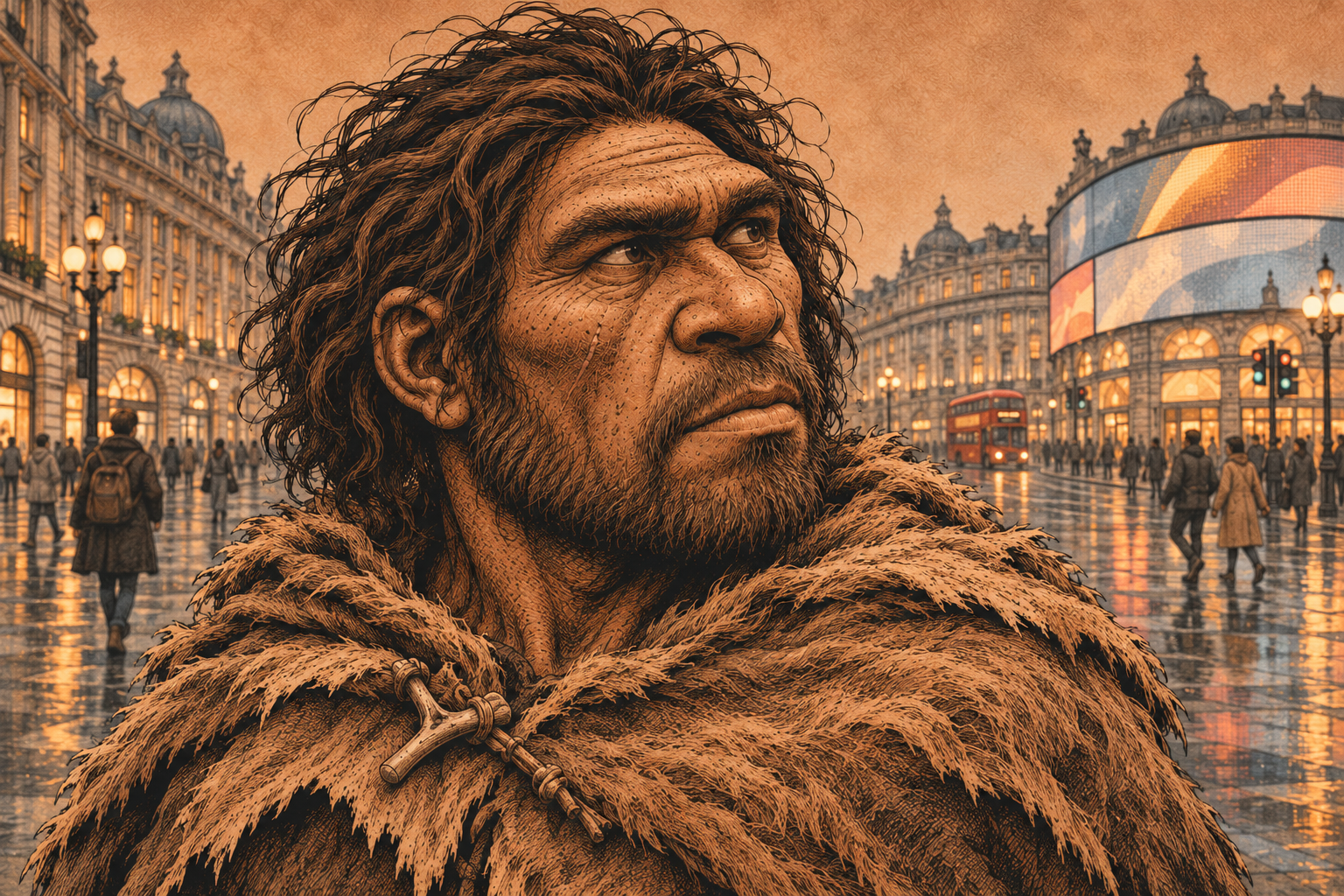 THE CHALLENGER / NEANDERTHAL
The Outsider
Our challenger is a healthy adult, suddenly separated from his community. His knowledge of tools, materials and the natural world comes with him. Everything about modern London has to be learned.
 THE SETTING / MODERN LONDON
The City
London puts meals behind checkout screens, journeys behind ticket barriers and accommodation behind arrangements he cannot explain or negotiate. The resources are here. Access is the challenge.
| Challenge | What helps | What he must learn |
|---|---|---|
| Food and water | Experience recognising and processing familiar foods | Payment, asking for help and reliable access |
| Shelter | Attention to cover, materials and weather | Finding dependable accommodation in an occupied city |
| Getting around | Observation and memory of routes | Traffic signals, ticketing and destinations |
| Other people | Gestures, repeated encounters and shared attention | Language, local expectations and whom to trust |
The setup is fictional. We assume no English, money, ID, phone or modern knowledge. Assistance is allowed and supported survival counts. The illustrations imagine individual encounters, clothing and locations.
What would he
bring with him?
Practical intelligence.
Neanderthals made sophisticated tools, controlled fire, used shelters and ate animal and plant foods. Those skills provide a credible starting point for our fictional challenger.
Source 1 · SmithsonianA stocky build.
Neanderthals had relatively short, heavily built bodies associated with cold environments. Our illustration exaggerates his size for the comic. It cannot tell us how well an individual would cope with a year outdoors.
Source 2 · Natural History MuseumA communication question.
A 2021 study modelled Neanderthal hearing and found capacities compatible with efficient vocal communication. It leaves the structure of their language and their ability to learn English unresolved.
Source 3 · Nature Ecology & EvolutionFive tests.
Twelve months.
Each problem feeds the next. A safe first encounter could unlock food, shelter and the time to learn.
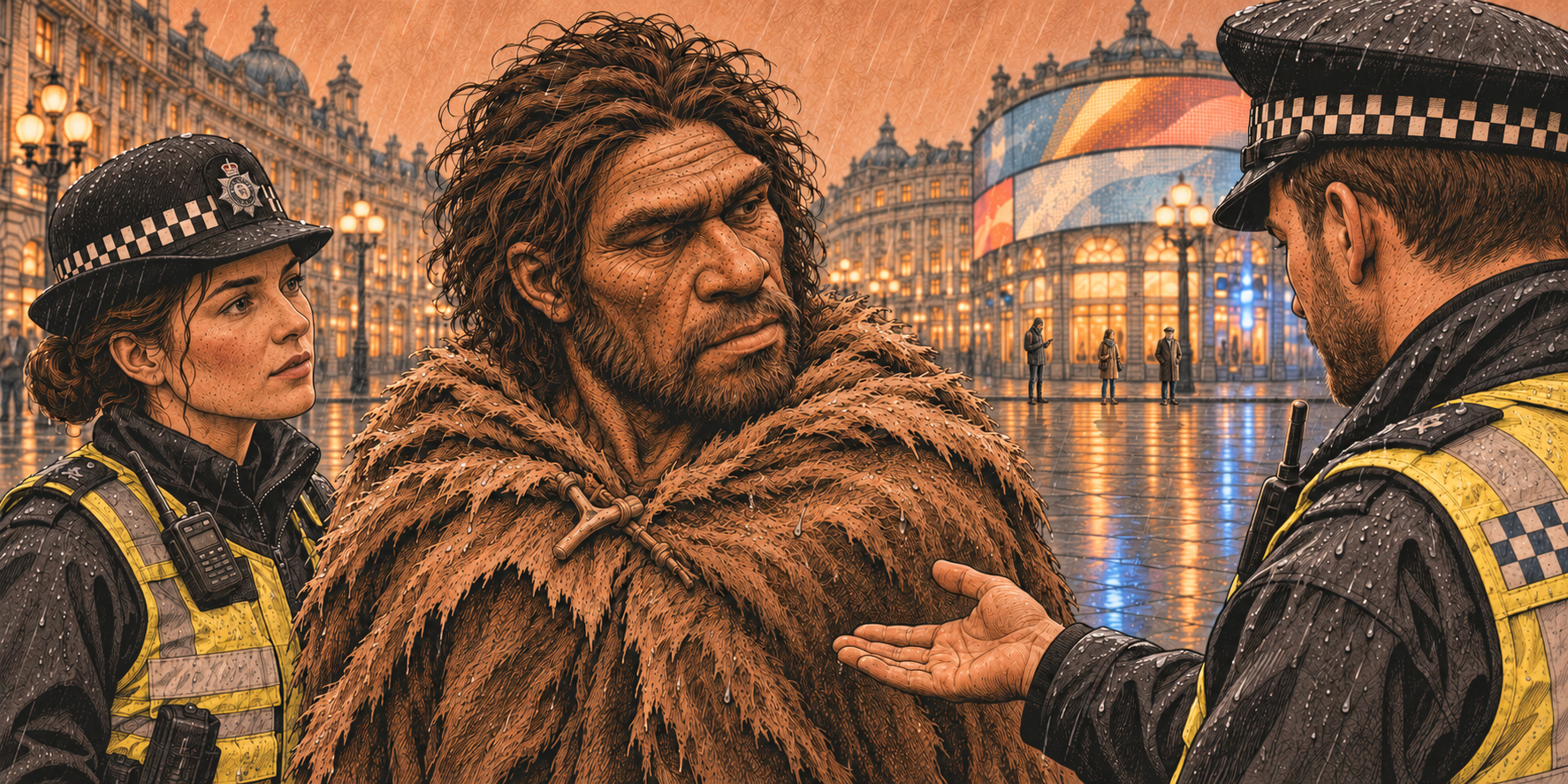
Everyone notices.
A bus is a moving wall of noise. Crowds stream around him. Someone raises a phone. He cannot explain who he is or understand an officer’s questions. A calm gesture could become the first bridge between his world and ours.
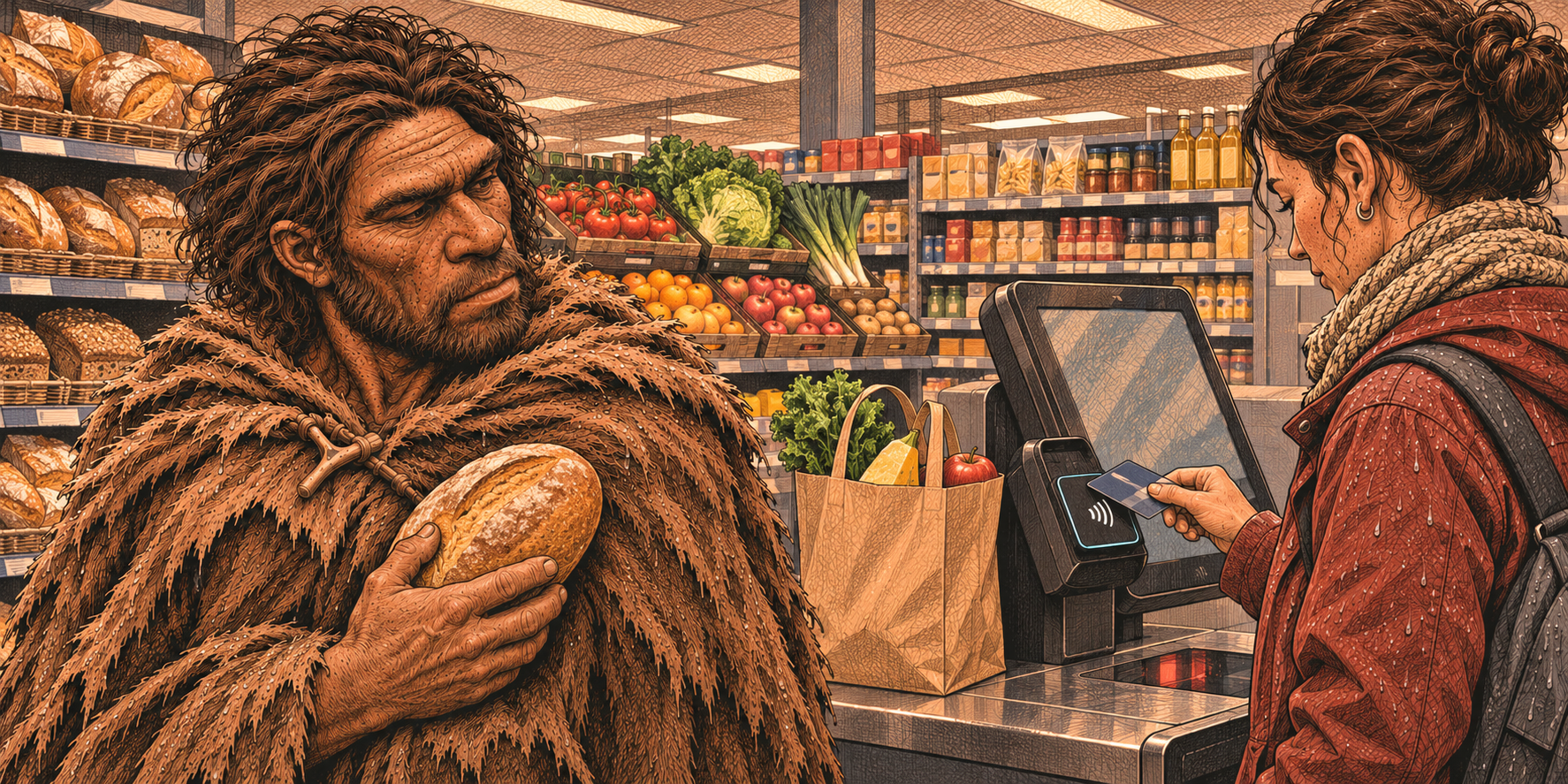
Plenty of food.
No familiar rules.
He recognises food. The mystery is how people take it away. He watches a shopper hold a small rectangle against a machine and leave with a bag. Learning that sequence would still leave him needing a way to pay, ask for help and find something to drink.

A roof changes the story.
A bridge offers an obvious answer to rain. It gives him a place to pause and watch the city. But twelve months demand more than a dry corner. Dependable accommodation, clean clothing and somewhere to rest would make a far greater difference.
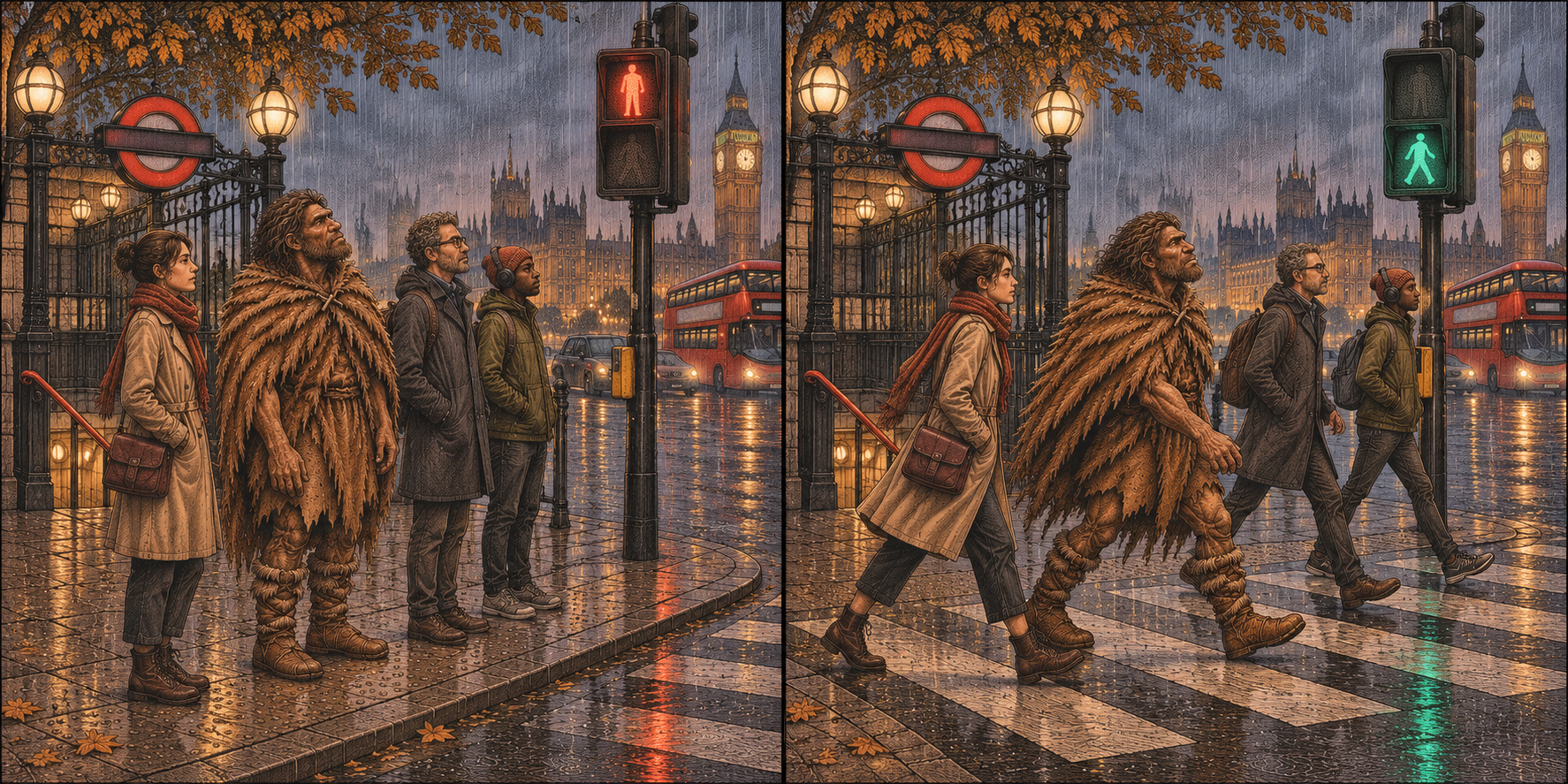
The city has patterns.
People stop together, then move together. A repeated gesture leads to food. A familiar face appears at the same time each morning. Those patterns give him something to work with, although we cannot measure how quickly he would learn the language or make sense of the city.
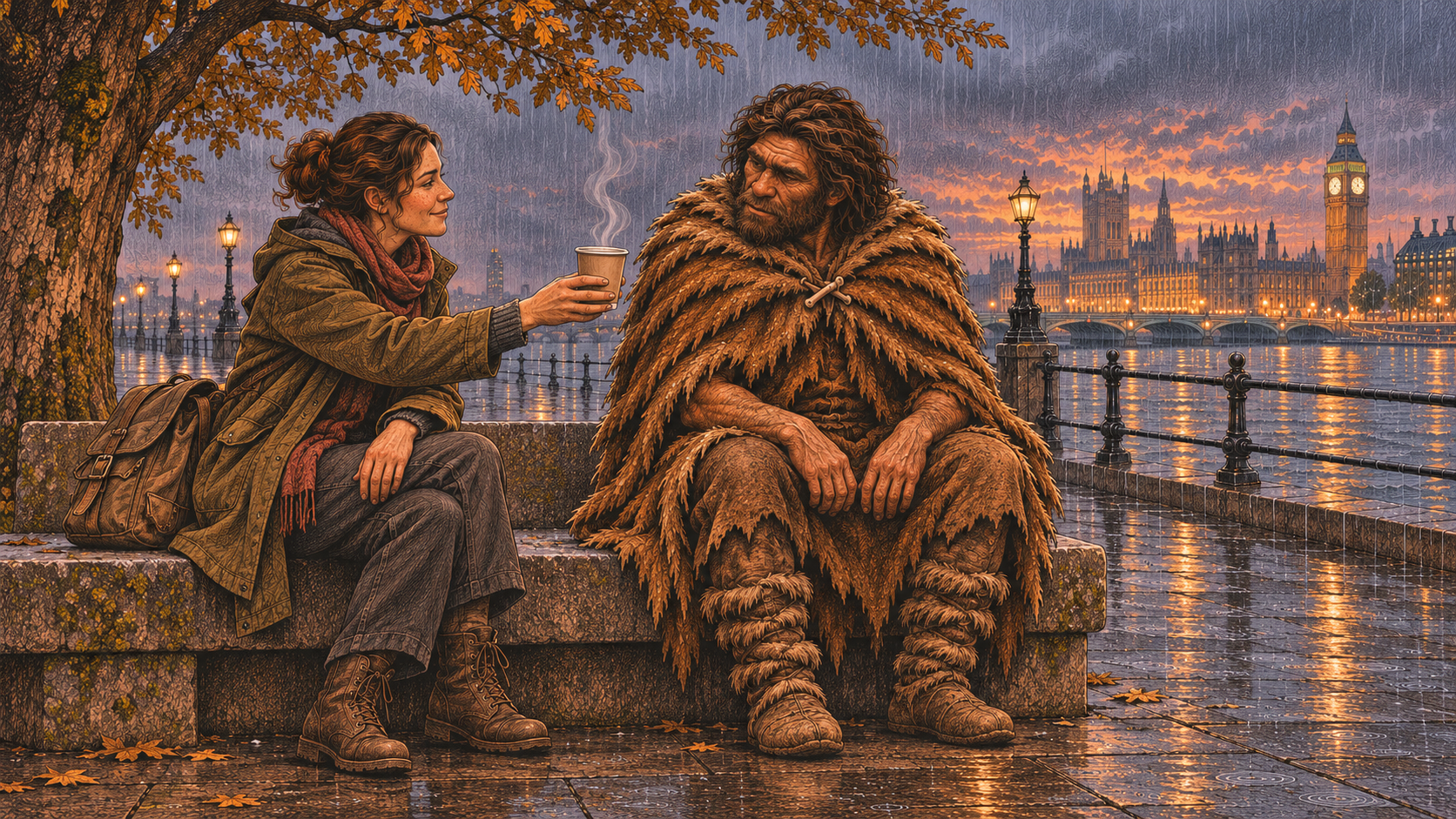
Survival becomes social.
A warm drink is a small gesture. A person who comes back tomorrow could change everything. With patient support, he gains time to learn, a way to communicate basic needs and someone who can help him navigate services. That relationship becomes the strongest advantage in the experiment.
Surrounded by people.
Still on his own.
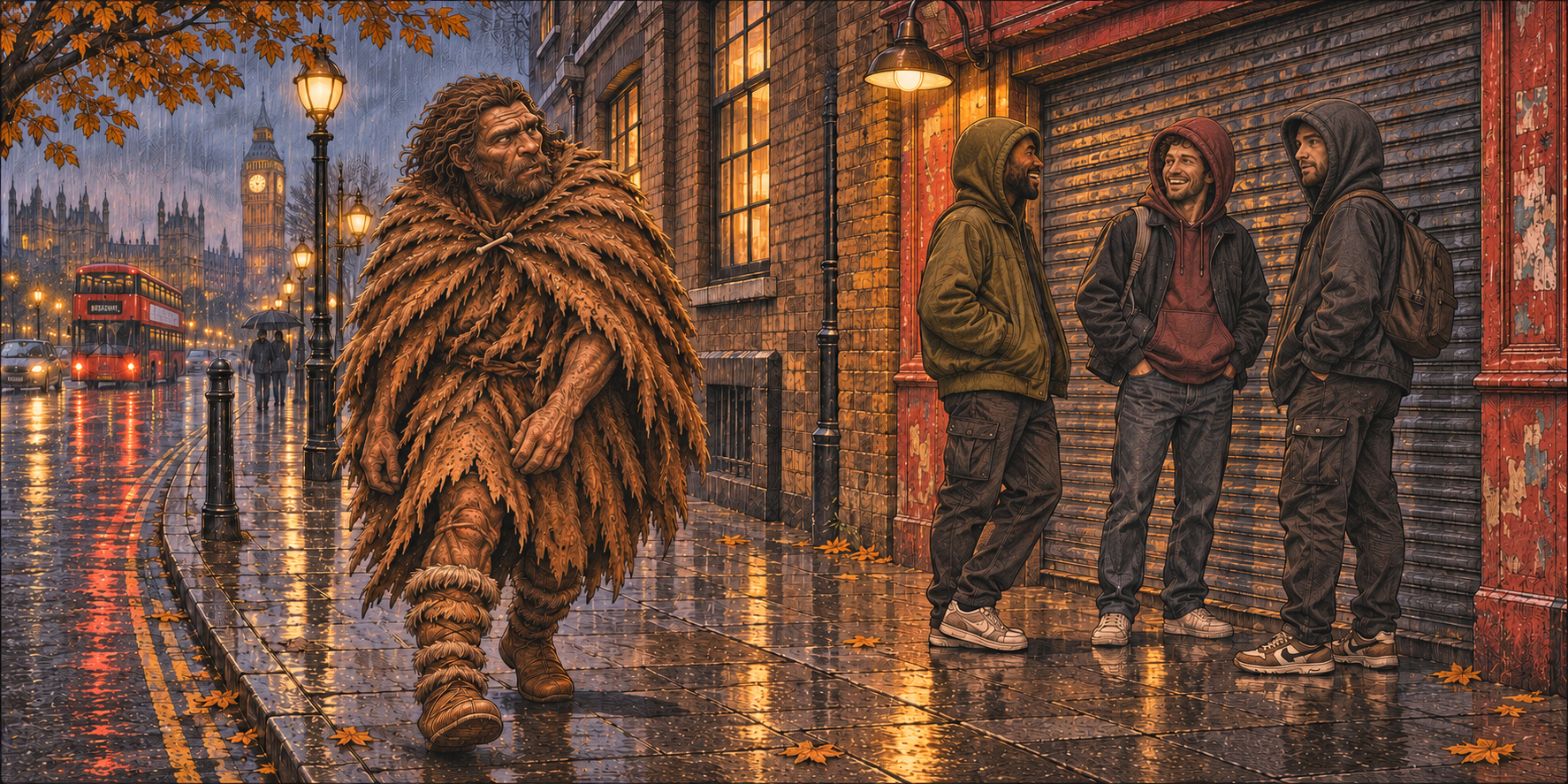
Who can he trust?
He passes three men talking beneath a streetlight and glances back. Their laughter tells him little. He has no shared language to judge the conversation, and they have no way to read his unease. An ordinary encounter can feel uncertain when every social cue is unfamiliar.
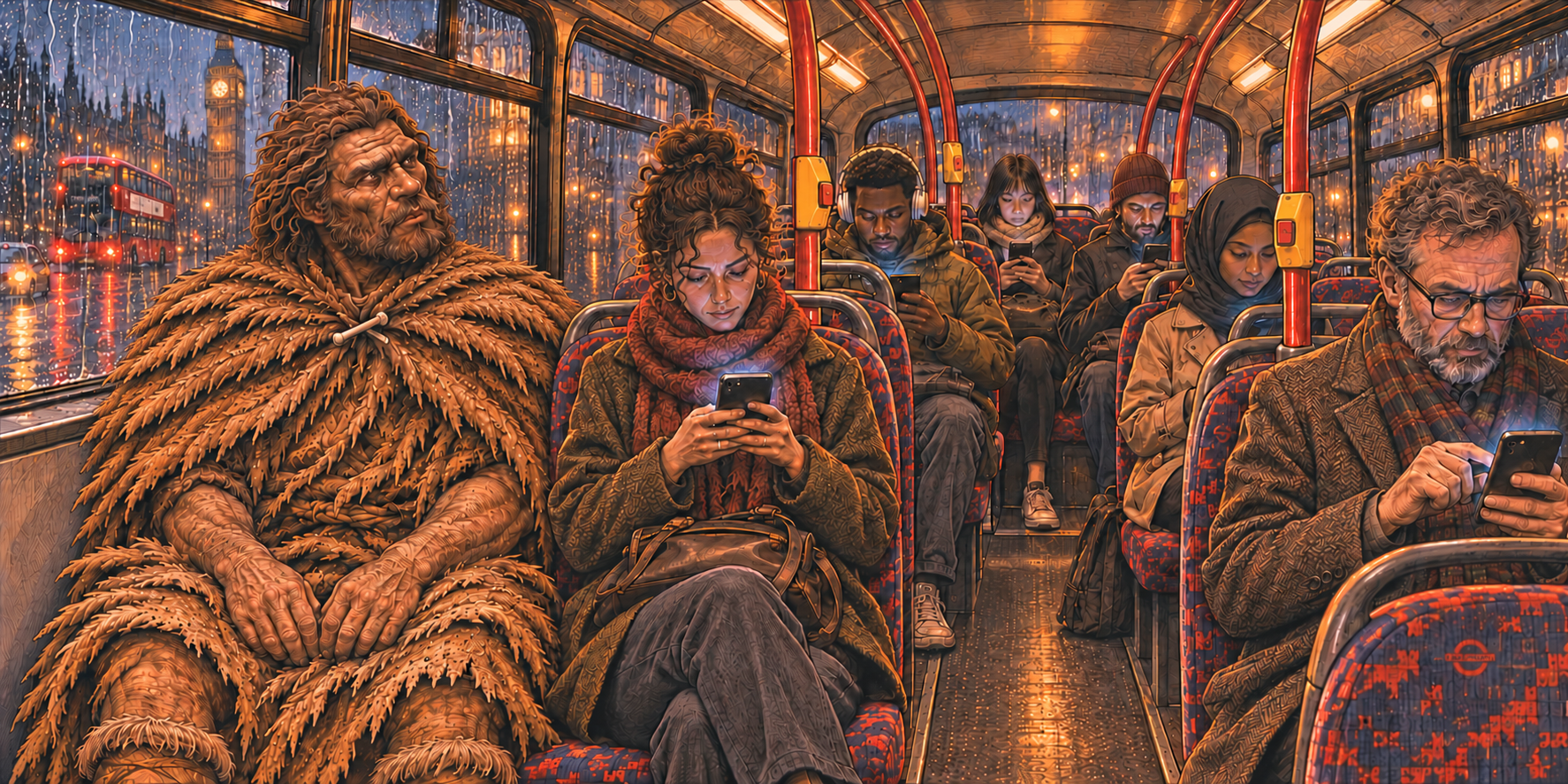
A full bus. Nobody looks up.
Imagine someone has helped him board. He sits among passengers staring at glowing rectangles, each absorbed in a private conversation. The bus carries him through London, but understanding where to get off is another puzzle. Being near people gives him opportunities for contact. Turning one into a useful exchange takes more.
The first night.
An imagined scene from his first evening in the city.

The city never
goes quiet.
He draws his knees beneath the hide cloak and listens. Footsteps cross the bridge above him. Engines rise and fade. Across the water, a wheel of light turns against the sky.
The little fire gives him something familiar to watch. Everything beyond it follows rules he cannot yet read. He has found a place to sit, but he has no idea what morning will bring.
When daylight comes, he will have to try again. Somewhere among all those strangers, could there be someone willing to stay long enough to understand?
The deciding factor?
Other people.
Could he survive? With sustained help, a year is plausible within this fictional setup. Left isolated, we would back London. His practical skills give him resources to draw on, but reliable food, shelter and communication decide whether he gets the chance to use them.
Severe obstacles.
Food access, shelter, communication and unfamiliar hazards remain recurring problems. We would not favour this route.
A different prospect.
Reliable help with food, shelter and communication could make survival plausible. His long-term adjustment remains uncertain.
This verdict is an editorial judgement. No evidence can supply a reliable survival percentage for this time-travel scenario.
What if nobody helps him?
He faces recurring problems with meals, shelter and communication. Our judgement would shift strongly against surviving the full year. There is no defensible percentage to attach to that outcome.
What if he arrives with a modern guide?
A patient guide could explain everyday routines, help him obtain essentials and build a way to communicate. With those needs supported, the story becomes one of adjustment over the year.
Does surviving mean living independently?
Success here means being alive after twelve months, including with assistance. Independent living adds further demands involving communication, income and accommodation.
Follow the evidence.
- Smithsonian Human Origins Program · Homo neanderthalensis. Species overview supporting the discussion of tools, fire, shelters and diet.Read the Smithsonian species overview ↗
- Natural History Museum · Who were the Neanderthals? Lisa Hendry’s overview, drawing on Professor Chris Stringer’s research, covers appearance, lifestyle and archaeological evidence.Read the Natural History Museum guide ↗
- Conde-Valverde and colleagues · 2021. “Neanderthals and Homo sapiens had similar auditory and speech capacities”, Nature Ecology & Evolution 5, 609–615. The study uses anatomical modelling to examine hearing. It does not test modern language learning.Read the research paper ↗
Sources checked 17 November 2026. The London encounters, timetable and survival verdict are fictional extrapolations. Illustrations use artistic licence in anatomy, clothing and London geography.