

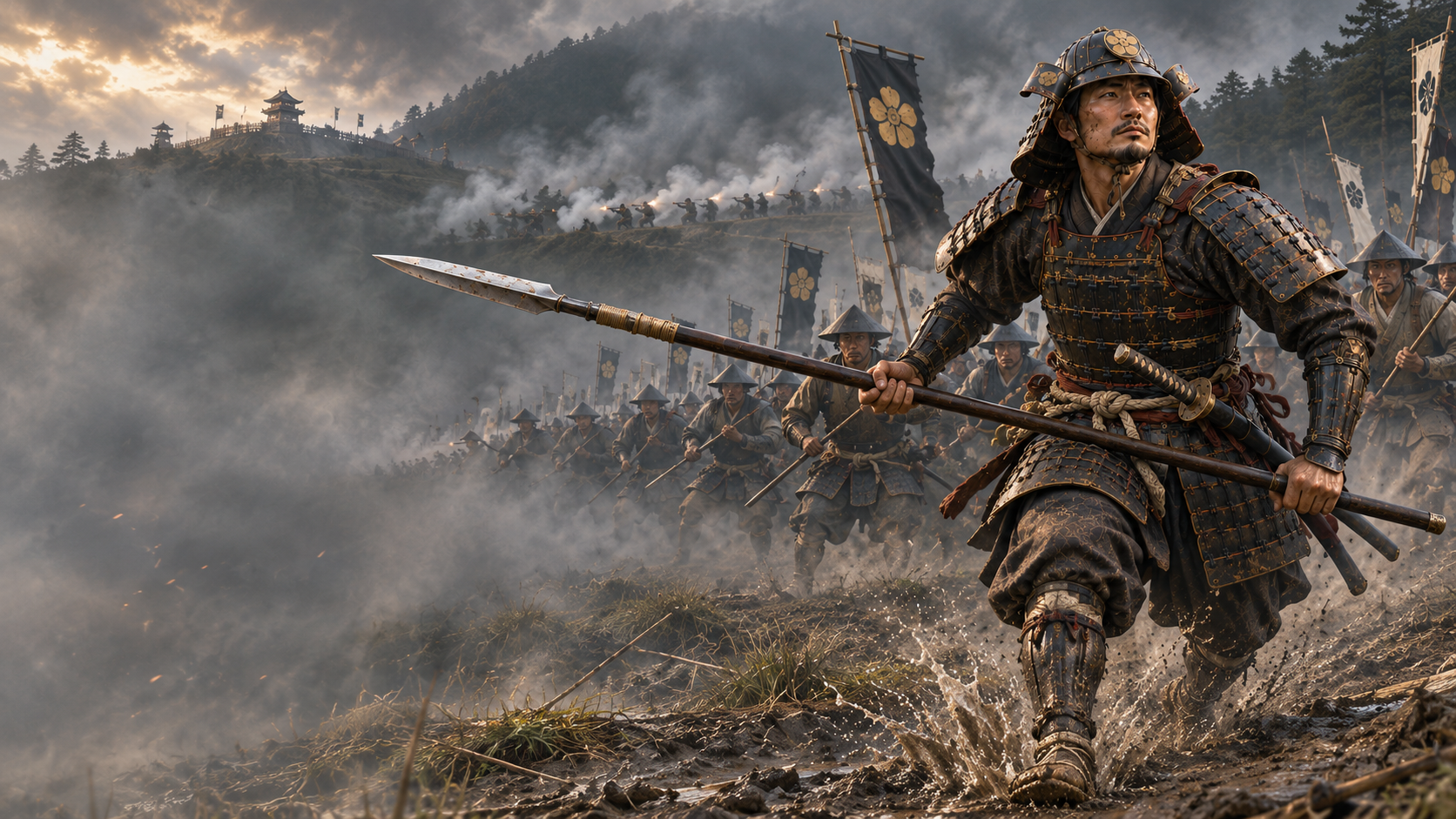
Lords of Showdown · Card 001 · Blades & Bows
The sword is at his hip. The spear is already in his hands.
Why reach for a spear when you carry a katana? In Japan around 1580, the answer could come down to how much ground you had to hold and what was coming towards you. Card 001 follows an imagined veteran through a battlefield of spear lines, bowmen and matchlock fire.
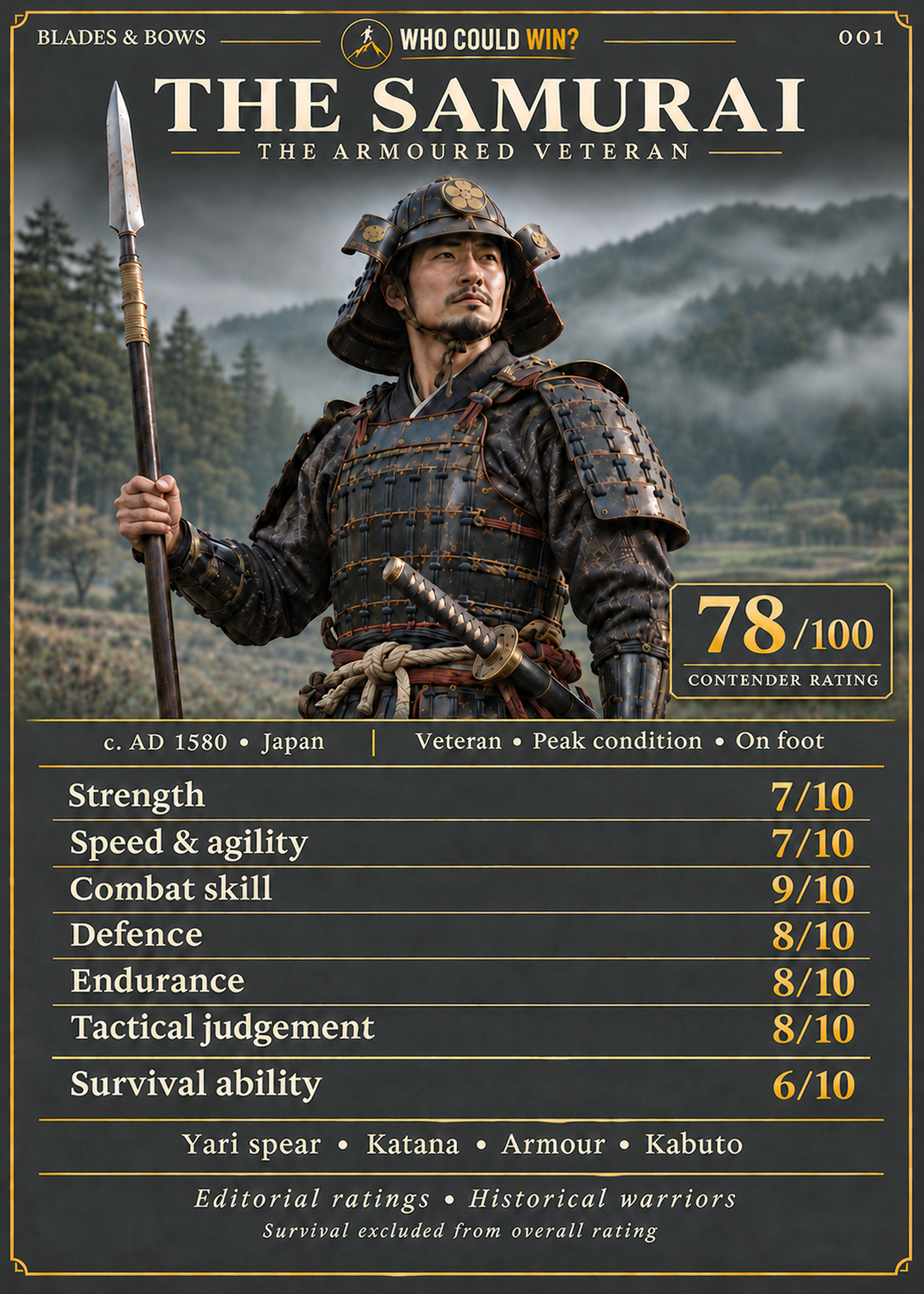
- Setting
- Japan, c. 1580
- Role
- Armoured veteran on foot
- Card equipment
- Yari spear, katana, armour and kabuto helmet
- Contender rating
- 78/100 · editorial
- Card ratings
- Strength 7, speed and agility 7, combat skill 9, defence 8, endurance 8, tactical judgement 8 (all out of 10).
- Survival ability
- 6/10 · scored separately
When did the samurai live?
Japan’s warrior class had roots in the Heian period (794–1185) and rose to political prominence by the late 12th century. Samurai retained privileged status through the Edo period and into the Meiji transition, when reforms dismantled those privileges in the 1870s. For this card, the late 1500s are the featured battlefield era. Large armies, rival warlords and the spread of firearms make it a particularly revealing time to compare a spear-armed veteran with other fighters. The Met’s arms and armour exhibition · Oleg Benesch on the warrior class
What was Japan’s climate like in the 1500s?
For a campaign in central Honshu around 1580, humid summers and cold winters are a reasonable starting point. The season and location mattered. A mountain route or a march on the Sea of Japan side could bring heavy winter snow, while conditions on the Pacific side could be quite different. Summer rain could turn an unpaved road muddy and make a march slower. Japan Meteorological Agency’s guide to regional climate
Tree-ring reconstructions place the 1500s within a long period of cooler winters in central Japan known as the Little Ice Age. Other tree-ring studies track shifts in summer humidity. These records help us describe the wider climate, while the weather on any particular march would depend on the place, season and year. Central Japan winter reconstruction · Tree-ring evidence for summer climate
How tall was a samurai around 1580?
Who were his most dangerous enemies?
Which army he faced depended on whom he served. At Nagashino in 1575, just five years before our card’s setting, the combined forces of Oda Nobunaga and Tokugawa Ieyasu defeated Takeda Katsuyori’s army. A veteran serving the Takeda there would have faced defenders with matchlocks. The battle illustrates the danger of crossing ground under gunfire, even for a fighter whose spear gives him an advantage at close range. Smithsonian battle screen and commentary
Weapons, armour and clothing
Yari. The spear gives this veteran reach, so it is the first weapon he brings into play when he has room. The Met holds a surviving steel su-yari blade from the 16th century. Katana. His sword gives him a shorter weapon if he loses the spear or the space to use it. Bows and matchlocks also belonged to the period’s arsenals. See the 16th-century spear blade
Armour. The kabuto protects his head. The cuirass and other defences cover parts of his body while leaving joints and openings that an opponent can exploit. Surviving suits show considerable variation. Off duty, a kosode, a robe with small wrist openings, is a period clothing reference. The elaborate fabrics preserved in collections often tell us more about wealth and status than about an ordinary veteran’s wardrobe. See late-16th- to early-17th-century armour · See a surviving kosode
Did samurai fight on horseback?
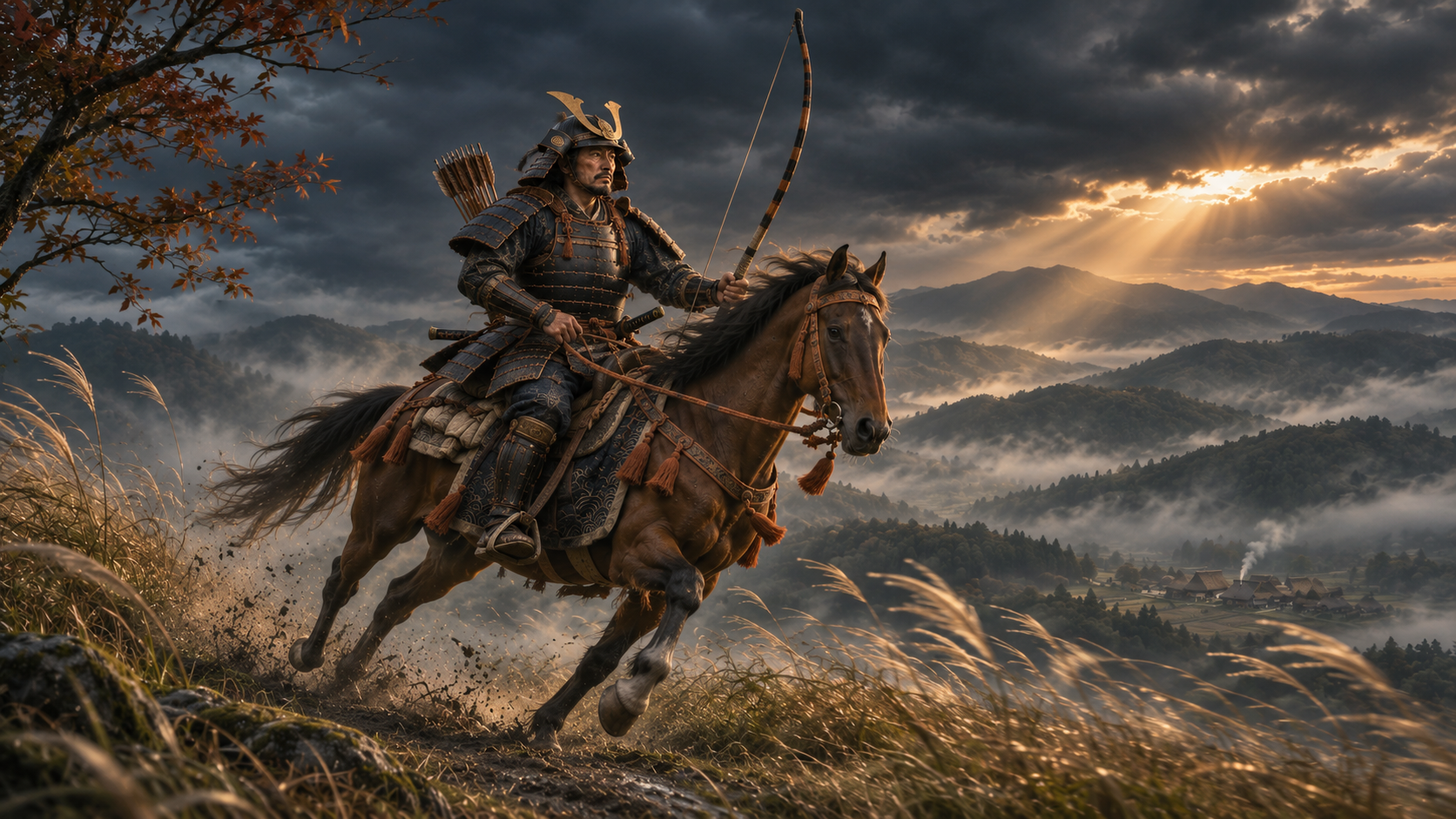
Yes. Horsemanship was an important skill, especially among higher-ranking samurai. Earlier mounted warriors used bows from the saddle, and the box-shaped ō-yoroi armour was designed for mounted archery. By the 1500s, even warlords had to be ready to fight on foot. The Met’s dō-maru cuirass from around 1550 shows how closer-fitting armour gave the wearer more freedom to move. Card 001 rates the veteran on foot with his yari. The Met on mounted archers’ armour · See the c. 1550 cuirass
What did samurai believe?
Buddhist and kami worship could overlap. Hachiman, a deity associated with war, appears by name on surviving Japanese armour. The Met’s helmet crest shows how warriors could invoke him through their equipment. It gives us a concrete example of devotion, while this veteran’s own beliefs remain unknown. See the Hachiman crest
What did honour mean to a samurai?
For a warrior around 1580, honour could mean keeping his reputation, serving his lord and showing courage under pressure. Those expectations varied with clan, rank and circumstance. Bushidō means “the way of the warrior”. Historian Oleg Benesch traces the familiar idea of a shared samurai code to debates during Japan’s modernisation, centuries after this veteran’s time. Read Benesch’s history of bushidō
How did samurai behave in war?
In 1571, Oda Nobunaga’s forces attacked Mount Hiei, killing people and burning religious buildings. In 1587, Toyotomi Hideyoshi condemned the sale of Japanese captives abroad, describing the families they were torn from and demanding their release. The first example shows what an army could do under orders. The second shows what a ruler publicly condemned in an edict that also restricted Christian missionaries. Neither reveals the private feelings of an ordinary retainer. Mount Hiei’s memorial (PDF) · Read Hideyoshi’s edict in translation
Card 001, imagined. Picture a veteran who shares his rations with the man beside him, then receives an order to burn an enemy village. What does he owe the people in his unit, and where does he draw the line when obeying his lord means harming someone else?
What did he eat on campaign?
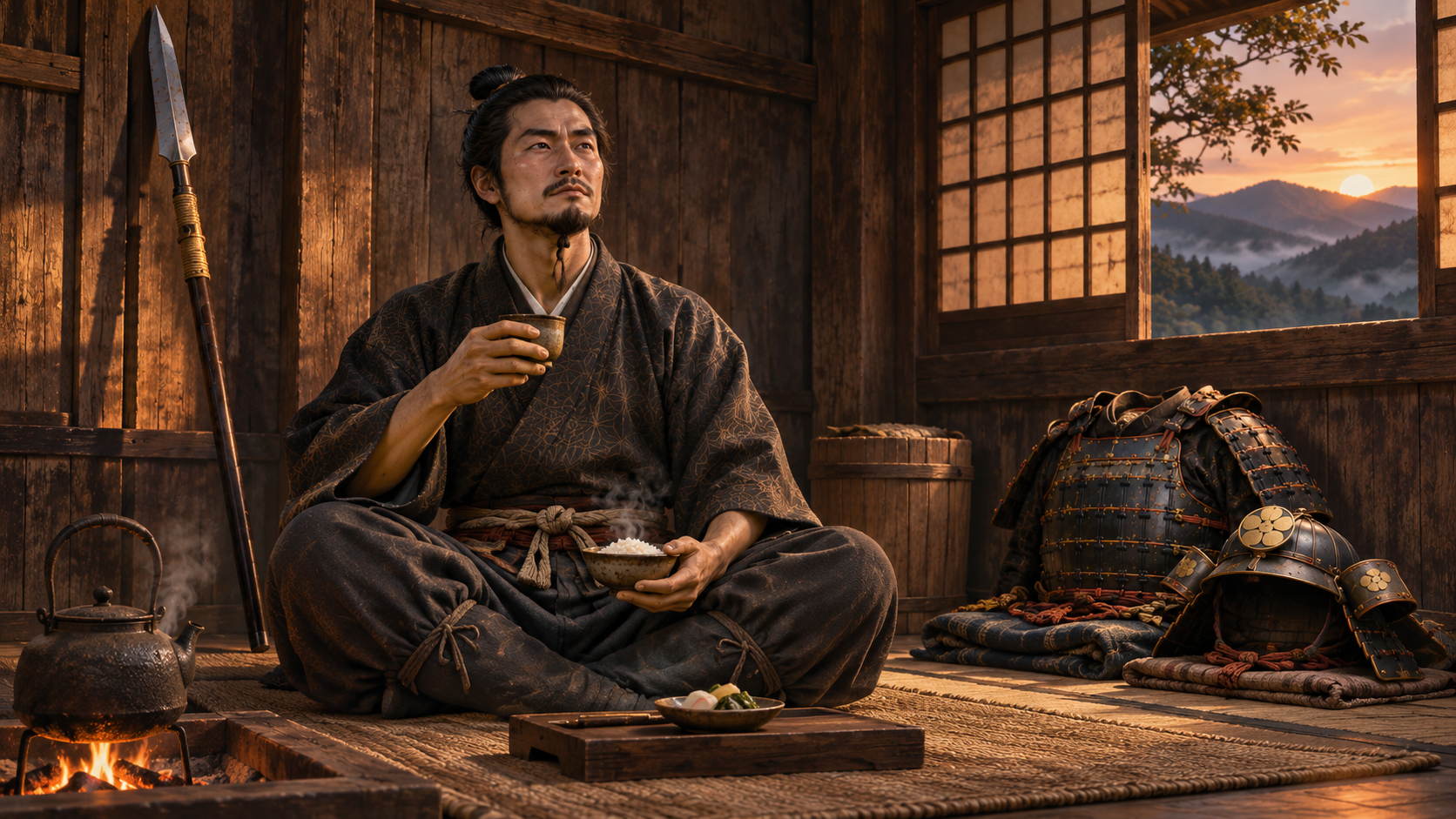
Miso is one provision we can point to with some confidence. Japan’s agriculture ministry notes that its keeping qualities made it valuable in the Sengoku period. Research on the Mōri family’s campaigns also gives us a way to look at how armies secured provisions. The rice bowl in our illustration is a plausible meal detail. We don’t have a daily menu, portion size or ration allowance for this imagined veteran. Japan’s agriculture ministry on miso (Japanese) · Hiroshima University repository study on Mōri provisioning
Who was Japan’s most famous samurai?
Miyamoto Musashi (c. 1584–1645) is one of Japan’s best-known swordsmen. Born a few years after the setting of Card 001, he became renowned for his two-sword style and wrote The Book of Five Rings, a work on swordsmanship and strategy. The details of his early life are uncertain. His own writing offers a more direct way to explore how he thought about fighting. Read the Japan Tourism Agency’s profile of Miyamoto Musashi (PDF)
Elsewhere in 1580 · The Guachichil Archer
In what is now north-central Mexico, Guachichil fighters were among the Indigenous peoples resisting Spanish colonial expansion during the Chichimeca War. The roads supplying the silver mines around Zacatecas were a focus of fighting. A Guachichil archer is a contemporary of our armoured samurai and a different kind of fighter, using a bow on a contested frontier. Read Ruth Behar on Guachichil resistance
There’s no known encounter between these two warrior types. They belong to separate conflicts taking place in the same era.
The scene illustrations are AI-assisted depictions of an imagined warrior.